
Beach Scene — History & Facts
Here, the passage of time collides with the vibrancy of life, capturing a fleeting moment on the sandy shore. Each brushstroke unveils the beauty of decay, revealing the impermanence that defines existence. Look to the lower right, where the soft, weathered sand meets the gentle lapping waves. The delicate strokes of light blue and white create a frothy dance, which contrasts beautifully with the earthy tones of the beach.
Notice how the figures in the distance are rendered with a light touch, suggesting transience, as if they might dissolve into the very air around them. The warm golden hues of sunset imbue the scene with a nostalgic glow, inviting the viewer to linger yet acknowledging the inevitable passage of time. Within the gentle chaos of the waves lies a deeper narrative—an interplay of joy and longing. The scattered shells, scattered among the sand, hint at lost stories; their empty forms echo the lives once lived.
A solitary figure, painting in the distant surf, embodies both the artist and the viewer's yearning to capture moments before they slip away, preserving the ephemeral beauty of the beach experience amidst the encroaching decay. Created in 1865, this piece reflects James Hamilton’s engagement with the coastal landscapes of England, where he frequently found inspiration. During this period, the world of art was evolving, with the rise of Impressionism challenging traditional techniques. Hamilton, often embracing a blend of realism and emerging modern influences, sought to encapsulate fleeting moments like this, amidst broader societal changes in post-Victorian England.
More Artworks by James Hamilton
Browse all →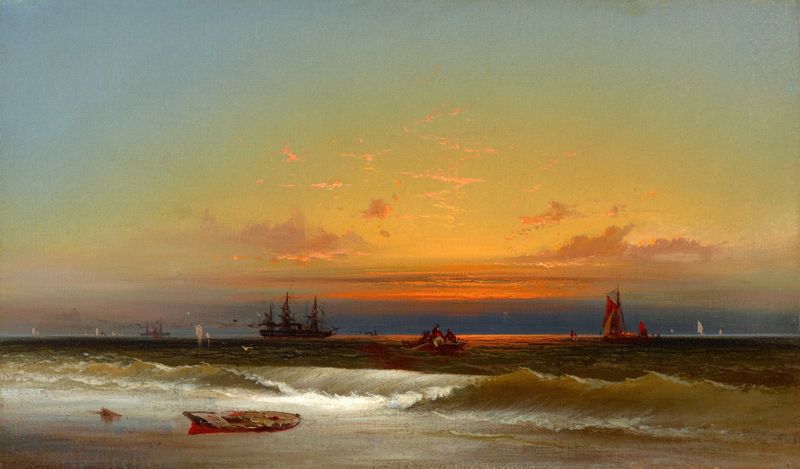
Sunset Seascape
James Hamilton

Evening on the Seashore (Sunset Breakers Philadelphia Harbor)
James Hamilton

Scene on the Hudson
James Hamilton

Beach Scene at Sunset
James Hamilton
Seascape
James Hamilton

Rounding the Cape, Sunset
James Hamilton

Beach Scene with Dramatic Sky
James Hamilton

From the Tempest
James Hamilton





