
Bäume im Nebel — History & Facts
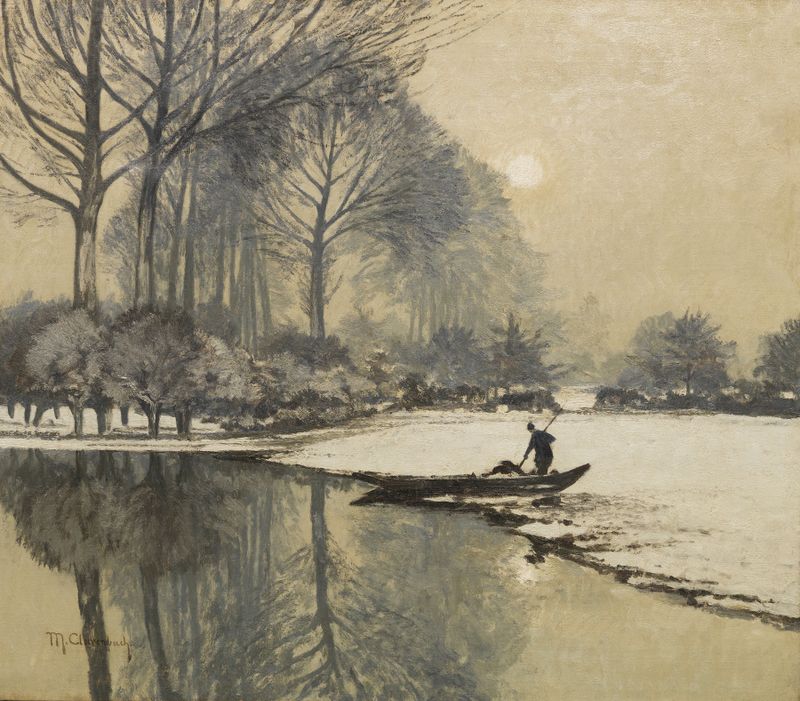
When did color learn to lie? In Bäume im Nebel, the trees stand like silent sentinels, cloaked in an ethereal mist that shrouds them in ambiguity and dread. This fog blurs the boundary between reality and illusion, evoking the unsettling nature of fear that lies beneath the surface of the serene landscape. Look to the center where the trees emerge ghostlike from the swirling gray. Notice how the soft brushwork creates a sense of movement, as if the mist itself is alive, wrapping around the trunks and branches.
The subdued palette of greens and grays instills a melancholic atmosphere, and the delicate interplay of light and shadow adds depth, suggesting layers of hidden emotion within the apparent tranquility of nature. Yet, beneath this serene façade, the painting whispers of isolation and uncertainty. The indistinctness of the background suggests the unknown lurking just out of sight, while the trees, though steady, evoke a sense of vulnerability. They seem to both protect and imprison, standing firm yet isolated, reflecting the tension between nature's beauty and the innate fear it can evoke in the human psyche. Max Clarenbach created this haunting piece in 1909 during a period of personal reflection and change.
Living in Germany, he was inspired by the Symbolist movement, which sought to evoke emotion through color and form. Clarenbach's exploration of atmospheric conditions in his landscapes was a significant departure from traditional representations, positioning him within the broader context of early 20th-century art that began to question the intersection of reality and perception.
More Artworks by Max Clarenbach
Browse all →
Winter an der Erft
Max Clarenbach

Winterlandschaft
Max Clarenbach

Nordseestrand – Vlissingen
Max Clarenbach

Winterlandschaft am Niederrhein, bei Wittlaer
Max Clarenbach

Flussufer
Max Clarenbach

Meereslandschaft
Max Clarenbach
Winterlandschaft mit Kahnfischer
Max Clarenbach

Niederrhein – Treibeis
Max Clarenbach

Der Rhein bei Düsseldorf mit Blick auf die Schnellenburg
Max Clarenbach

Ansicht von Neuss mit St. Quirinus-Münster
Max Clarenbach





