
Meereslandschaft — History & Facts
Where does light end, and longing begin? In Meereslandschaft, the boundary blurs, inviting the viewer to lose themselves in an ocean of possibility and color. Look to the horizon, where deep blues of the sea meet a sky ablaze with golden yellows and soft pinks. The colors swirl and blend seamlessly, evoking both tranquility and restlessness. Notice how the gentle brushstrokes create a rhythm that mimics the waves, while the contrasting tones breathe life into the scene.
The foreground, muted in comparison, suggests a land reluctant to break free from its grounded existence, allowing the vibrant sky and churning waters to steal the focus. Yet, the painting speaks of more than just a scenic view. The tumultuous waves can be seen as a metaphor for emotional upheaval, hinting at the inner struggles of those who gaze upon it. The light, while illuminating, casts shadows that suggest a yearning, creating a tension between the serene beauty of nature and the chaos that often lies beneath.
Each stroke conveys a longing for connection and understanding, pulling the viewer deeper into contemplation. In 1902, Clarenbach painted this work in Germany, a time when the art world was shifting towards expressionism and the exploration of emotional truth. The artist was navigating his own personal transformations amid wider societal changes that urged artists to break from tradition. In this vibrant landscape, one can sense the pulse of a changing era, where color and emotion became intertwined, inviting audiences to explore the depths of their own longing.
More Artworks by Max Clarenbach
Browse all →
Winter an der Erft
Max Clarenbach

Bäume im Nebel
Max Clarenbach

Winterlandschaft
Max Clarenbach

Nordseestrand – Vlissingen
Max Clarenbach

Winterlandschaft am Niederrhein, bei Wittlaer
Max Clarenbach

Flussufer
Max Clarenbach
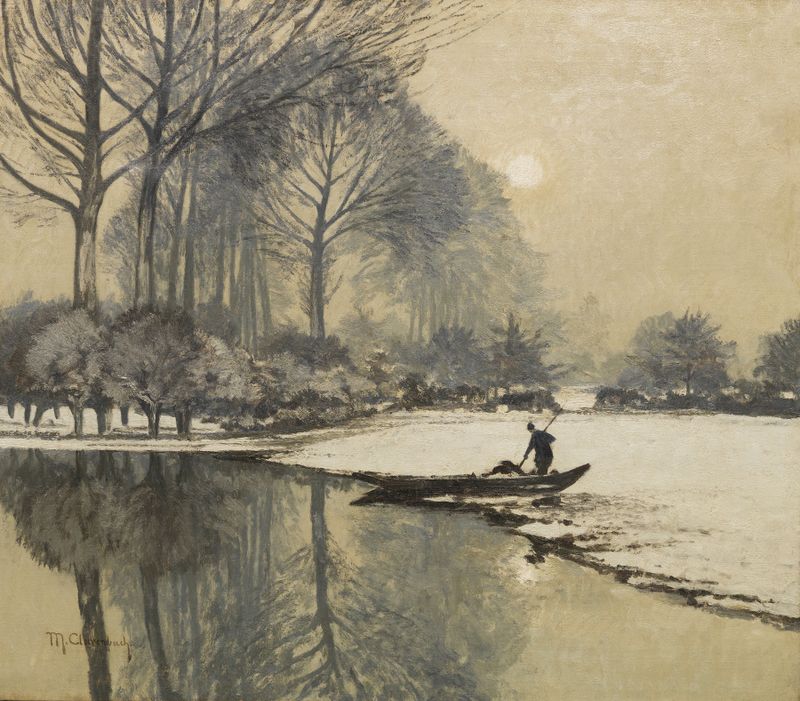
Winterlandschaft mit Kahnfischer
Max Clarenbach

Niederrhein – Treibeis
Max Clarenbach

Der Rhein bei Düsseldorf mit Blick auf die Schnellenburg
Max Clarenbach

Ansicht von Neuss mit St. Quirinus-Münster
Max Clarenbach





