
Niederrhein – Treibeis — History & Facts
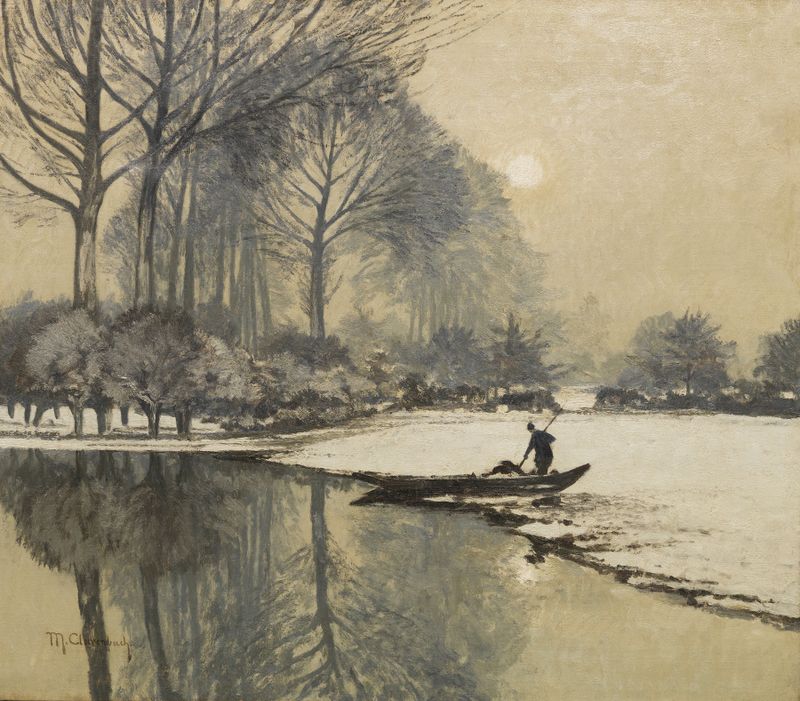
Who listens when art speaks of silence? In a world clouded by noise, the stillness captured can resonate more profoundly than any shout. Look to the bottom left where the river flows gently into the icy embrace of winter’s grip. The muted palette of blues and whites paints a landscape marred by loss, evoking an atmosphere heavy with nostalgia. Observe the delicate brushwork that defines the treibeis—fragments of ice drifting on the water’s surface, reflecting an ethereal glow that seems to whisper tales of abandonment.
The composition draws your eye across the horizon, where soft light obscures the land beyond, suggesting both distance and separation. Beneath the serene surface, a deeper tension simmers. The juxtaposition of the flowing river against the starkness of the ice evokes a sense of time standing still, symbolizing fleeting moments and the inevitability of change. Each piece of ice, isolated yet part of a larger expanse, reminds us of the connections we lose and the memories we carry.
This reflection on solitude and separation speaks volumes without uttering a single word. Created in 1910, this work emerged during a period of transition for Max Clarenbach, who was grappling with his own artistic identity amidst shifting trends in the art world. As a prominent figure in the German art scene, Clarenbach was influenced by the burgeoning expressionist movement, seeking to convey emotional depth through landscapes. The somber quality of Niederrhein – Treibeis mirrors the tumultuous social changes and personal loss he navigated, encapsulating a moment of introspection that resonates through time.
More Artworks by Max Clarenbach
Browse all →
Winter an der Erft
Max Clarenbach

Bäume im Nebel
Max Clarenbach

Winterlandschaft
Max Clarenbach

Nordseestrand – Vlissingen
Max Clarenbach

Winterlandschaft am Niederrhein, bei Wittlaer
Max Clarenbach

Flussufer
Max Clarenbach

Meereslandschaft
Max Clarenbach
Winterlandschaft mit Kahnfischer
Max Clarenbach

Der Rhein bei Düsseldorf mit Blick auf die Schnellenburg
Max Clarenbach

Ansicht von Neuss mit St. Quirinus-Münster
Max Clarenbach





