
Winterlandschaft — History & Facts
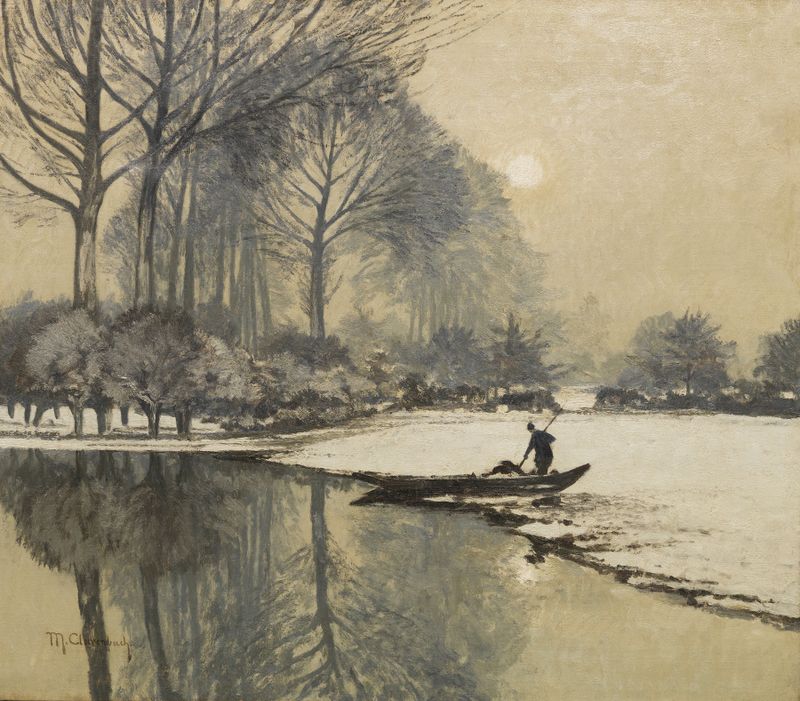
In the stillness of winter’s grasp, emotions linger like the frost on barren branches, encapsulating feelings of betrayal and loss in a world that feels suspended between reality and memory. Look to the foreground where the stark white landscape meets the delicate hues of twilight. Notice how the cool blues and soft grays of the snow contrast with the hint of warmth from the setting sun, casting long shadows that stretch across the scene. The careful brushstrokes create a sense of depth, inviting you to explore the untouched expanse.
Clarenbach’s attention to detail reveals a quiet beauty, yet an overwhelming loneliness permeates the composition, hinting at the stories buried beneath the surface. As you delve deeper, observe the distant silhouettes of trees etched against the horizon, their gnarled branches stark and twisted, evoking a sense of betrayal found in nature itself. The emptiness of the landscape serves as a metaphor for lost connections and hidden sorrows, suggesting that even in serene beauty, there may be unresolved pain. Each element within the painting refrains from mere representation, instead embodying the emotional weight of memories tethered to this wintry expanse. Max Clarenbach created this work during a period marked by personal and societal transformation, likely in the early 20th century in Germany.
At this time, artists grappled with the shifting dynamics of art and industry, exploring themes of nature and introspection as a response to the turbulence surrounding them. It was an era when the landscape became a canvas for articulating the complexities of human emotion, revealing what lies beneath the surface of our shared experiences.
More Artworks by Max Clarenbach
Browse all →
Winter an der Erft
Max Clarenbach

Bäume im Nebel
Max Clarenbach

Nordseestrand – Vlissingen
Max Clarenbach

Winterlandschaft am Niederrhein, bei Wittlaer
Max Clarenbach

Flussufer
Max Clarenbach

Meereslandschaft
Max Clarenbach
Winterlandschaft mit Kahnfischer
Max Clarenbach

Niederrhein – Treibeis
Max Clarenbach

Der Rhein bei Düsseldorf mit Blick auf die Schnellenburg
Max Clarenbach

Ansicht von Neuss mit St. Quirinus-Münster
Max Clarenbach





