Children in doorway — History & Facts
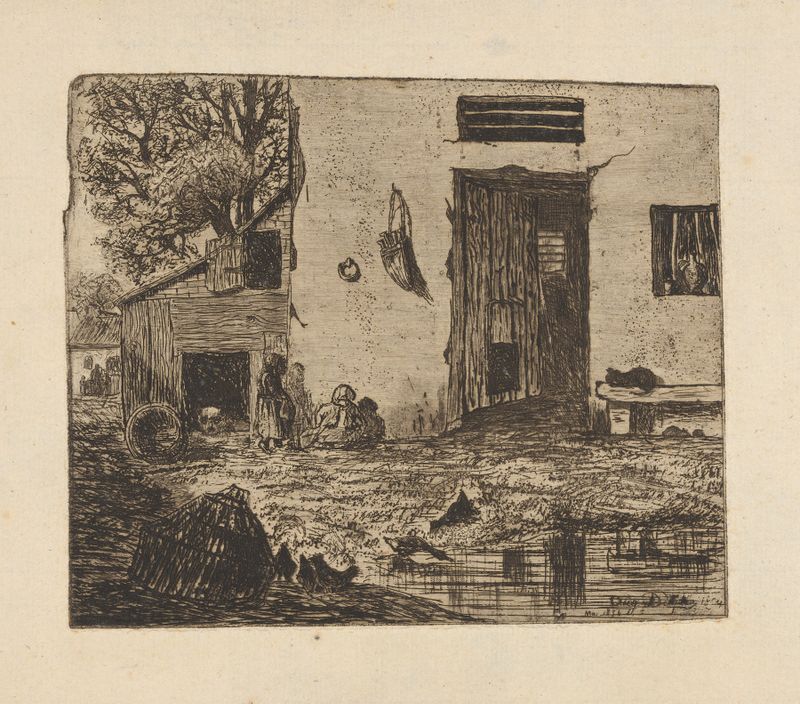
In the stillness of a moment captured, the promise of renewal lies at the heart of Auguste Delâtre’s Children in Doorway. Two figures stand framed by the entrance, embodying a sense of innocence poised on the brink of discovery. The world beyond the doorway beckons, offering the allure of adventure and the whisper of untold stories. Look to the center where the children gaze, their expressions caught between curiosity and shyness.
The warm hues of ochre and soft blues envelop them, contrasting with the cold shadows lurking just outside their sanctuary. Notice how the light streams into the doorway, illuminating their faces while leaving the background in enigmatic darkness, a visual metaphor for the duality between safety and the unknown. The doorway itself symbolizes a threshold — not just between physical spaces, but between childhood and the wider world. The subtle variations in the children’s postures hint at their emotional landscape; one child leans forward, eager to explore, while the other hesitates, embodying the tension between fear and excitement.
This interplay evokes a universal theme of rebirth, reflecting on the transition from innocence to experience. In 1858, Delâtre worked in a Paris alive with artistic innovation, where the Impressionist movement began to take shape. His choice to focus on the intimate yet powerful subject of children at a doorway reflects a personal exploration during a time of burgeoning change, both in his life and the artistic community. This painting stands as a testament to the complexities of youth and the enduring spirit of exploration.