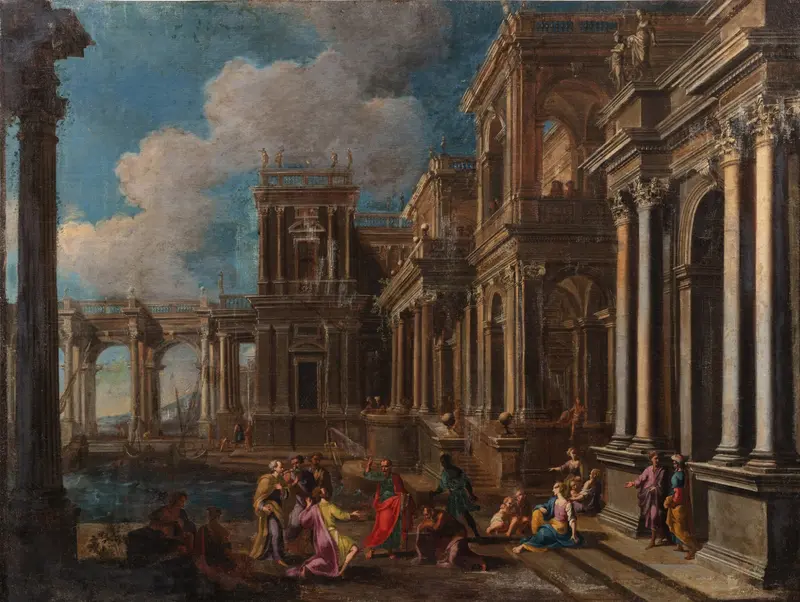
Classical Buildings with Columns — History & Facts
Sunlight pours through ruined arches and columns, drawing the eye deep into a city of memory and grandeur. Figures in flowing robes cross the stone steps, their gestures and glances animating the silent architecture. The statues above, half-shrouded in climbing greenery, seem to preside over both the living and the lost, while the careful play of light and shadow gives the ruins a sense of both decay and enduring dignity.
The palette, dominated by warm ochres and cool blues, sets a mood of reflection—this is not a bustling city, but a place where the past lingers and the present moves quietly through its echoes. Works like Classical Buildings with Columns by Alberto Carlieri belong to a tradition that flourished in the late Baroque and early Rococo periods, when artists and their patrons were captivated by the grandeur of ancient Rome. Such capricci—imaginary views of classical ruins—were often commissioned by wealthy collectors eager to display their taste and learning, or to decorate the walls of their villas with reminders of a lost golden age. The unknown date of this painting, now held in the Nationalmuseum from the collection of Erik Cornelius, only adds to its air of mystery.
History has kept few traces of its journey, but the image itself invites us to wander, to imagine ourselves among the columns, and to lose ourselves in the play of light and time.