
Coucher de soleil en Hollande — History & Facts
In Coucher de soleil en Hollande, light spills across a horizon poised between day and night, a fleeting moment of transformation captured on canvas. The painting invites the viewer into a world where the ephemeral becomes eternal, a reminder of the delicate balance between nature’s beauty and the passage of time. Look to the upper left, where the sun descends, casting a warm, amber glow that dances upon the water's surface. Notice how Jongkind's brushwork varies: the smooth strokes of the sky contrast with the textured ripples below, evoking the dynamic interplay of light and shadow.
The palette is rich yet understated, dominated by ochres and blues that blend harmoniously, reflecting both the serenity and the profundity of twilight. Yet, beneath its serene exterior lies a deeper narrative of change and impermanence. The silhouettes of boats on the water suggest movement, a subtle reminder of life's ongoing flow. Meanwhile, the vibrant sky hints at transitions—both of day into night and life into memory—evoking feelings of nostalgia and hope.
Each brushstroke becomes a testament to the artist's intent to capture not just a scene but a sense of what is inevitably fleeting. Johan Barthold Jongkind painted this work in 1868 during a time when he was establishing his reputation in France, influenced by the burgeoning Impressionist movement. Living in the vibrant art scene of Paris, Jongkind sought to explore the effects of light and atmosphere, reflecting the changing perceptions of nature in the rapidly modernizing world. The artwork embodies his desire to capture that which is in constant flux, inviting viewers to ponder the beauty of transient moments.
More Artworks by Johan Barthold Jongkind
Browse all →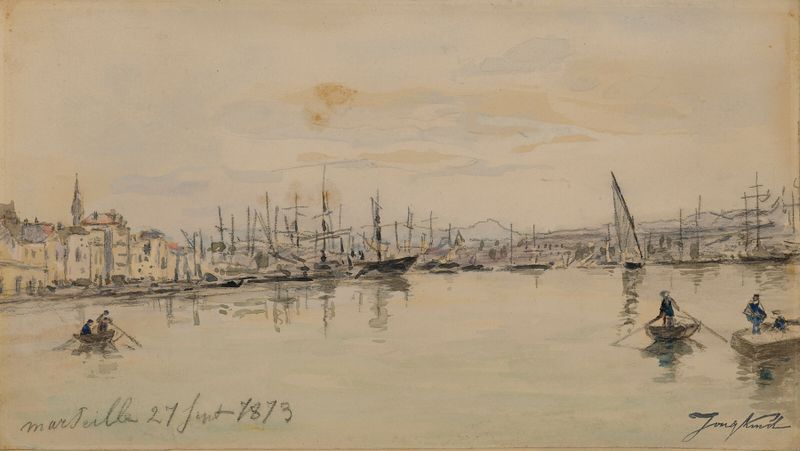
Le Port de Marseille
Johan Barthold Jongkind

Canal Saint-Martin
Johan Barthold Jongkind

Countryside near Brezins, between Grenoble and Vienne
Johan Barthold Jongkind

Notre-Dame vue du quai de la Tournelle
Johan Barthold Jongkind

Environs de Grenoble
Johan Barthold Jongkind

Clair de lune à Overschie (environs de Rotterdam)
Johan Barthold Jongkind

Port de Honfleur
Johan Barthold Jongkind
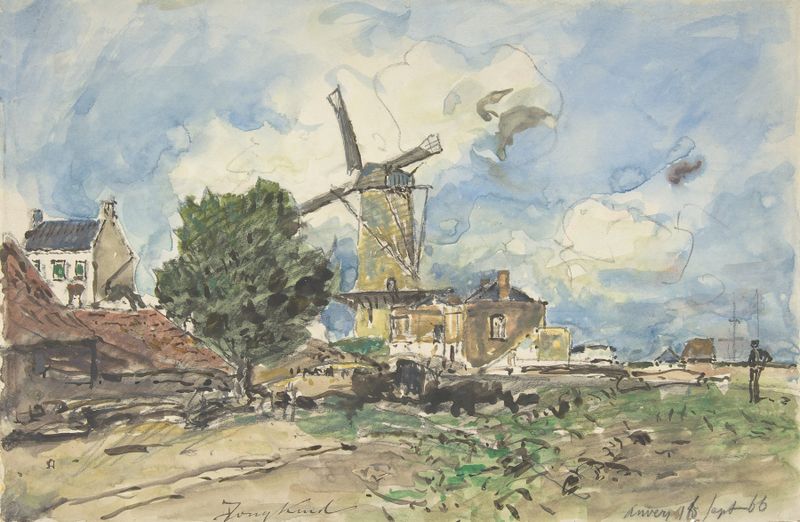
Wind Mill at Antwerp
Johan Barthold Jongkind

Le Havre
Johan Barthold Jongkind

The Church of Overschie
Johan Barthold Jongkind





