
Danish whaling cookery on the island of Danskoya at Spitsbegen — History & Facts
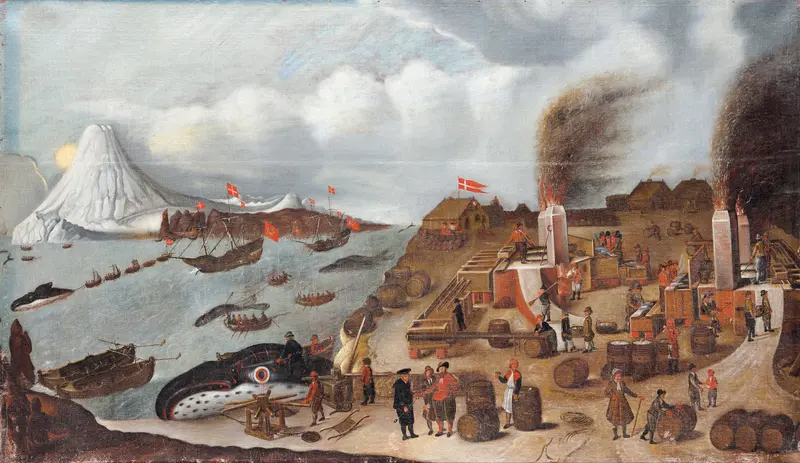
What first seizes the eye in Danish whaling cookery on the island of Danskoya at Spitsbegen is the sheer industrious choreography of men, ships, and smoke beneath a cold, looming Arctic sky. The painting pulls the viewer into a world where the hunt and its aftermath are inseparable: a whale, freshly hauled ashore, dominates the foreground, its massive form surrounded by workers already engaged in the grim but vital business of rendering blubber into barrels of oil. The Danish flags, vivid red against the muted earth and icy blue, punctuate the scene and declare both national pride and commercial ambition.
Billowing smoke from the tryworks rises in thick columns, drawing the eye upward and outward, while the distant mountain and sun remind us of the harsh, beautiful isolation of Spitsbergen. This work, dated 1634, belongs to a period when Arctic whaling was at its peak, driven by European demand for whale oil to light lamps and make soap. Paintings like this, often commissioned by merchants or whaling companies, served as both documentation and advertisement—visual proof of enterprise at the edge of the known world. The artist, Abraham Speeck, captures not just the labor but the organization and scale of these temporary settlements, with their makeshift factories and disciplined crews.
While history has kept few traces of individual hands or voyages, the painting itself—now preserved in the digital vaults of the Google Cultural Institute—remains a testament to the ambitions and hardships of an age when fortunes were made and lost on the ice. The more you look, the more you notice: each figure, each barrel, each plume of smoke is a fragment of a larger, restless story.
More Artworks by Abraham Speeck
More Genre Scene Art

Banquet of the Officers of the St George Civic Guard
Frans Hals

Rembrandt and Saskia in the Scene of the Prodigal Son
Rembrandt van Rijn

Bal du moulin de la Galette
Pierre-Auguste Renoir

Quadrille at the Moulin Rouge
Henri de Toulouse-Lautrec

A Burial at Ornans
Gustave Courbet

When Will You Marry?
Paul Gauguin