Disputation of the Holy Sacrament: meaning and characters
On the lower level an altar carries the consecrated host in a monstrance; above it, on clouds, Christ sits between the Virgin and John the Baptist, with God the Father and the Holy Spirit on the same axis and saints and prophets seated in a hemicycle. This is Disputation of the Holy Sacrament, also called La Disputa, a fresco by Raphael (1483–1520), painted around 1509–1510 in the Stanza della Segnatura of the Vatican Museums, a room whose frescoes, the museum says, mark the beginning of the High Renaissance.
- Heaven above, earth below: the fresco has two tiers. Above, the Triumphant Church is seated on the clouds, with patriarchs and prophets of the Old Testament alternating with apostles and martyrs. Below, the Militant Church gathers on the ground at the sides of the altar. The Getty's naming record adds that the perspective of the floor converges on the monstrance.
- Who sits on the clouds: from left to right the Vatican lists Saint Peter, Adam, Saint John the Evangelist, David, Saint Laurence, Judas Maccabeus, Saint Stephen, Moses, Saint James the Elder, Abraham and Saint Paul. The Italian page puts a question mark after Judas Maccabeus.
- Fathers of the Church: on the marble thrones nearest the altar sit four Fathers of the Latin Church: Saint Gregory the Great, Saint Jerome, Saint Ambrose and Saint Augustine. The Vatican says Gregory has the features of Julius II.
- Faces from history: the Vatican recognises Sixtus IV, Julius II's uncle, in the pontiff furthest to the right, Dante Alighieri behind him, and Fra Angelico in the monk on the extreme left.
- A title that is not quite right: the Vatican calls it the so-called Disputation and says its title should more rightly be the Triumph of Religion. The Getty's naming record also lists Disputation of the Most Holy Sacrament and the Italian La disputa del sacramento.
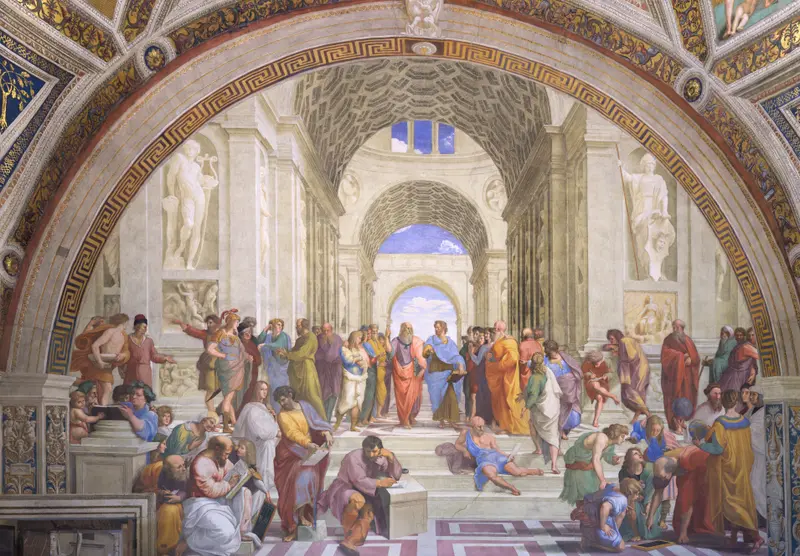
- Part of a library's programme: Julius II used the room as a library and private office, and the frescoes, painted between 1508 and 1511, stand for Truth, Good and Beauty. This wall, on the theme of theology, shows supernatural truth; the opposite wall, The School of Athens, shows rational truth. The Getty says the Disputa is thought to be the first fresco of the room.
Sources: Vatican Museums: Disputation over the Most Holy Sacrament · Vatican Museums (Italian page): Disputa del SS. Sacramento · Vatican Museums: Room of the Segnatura · Getty Museum: Raphael's Disputa · Getty CONA: Disputation of the Holy Sacrament · Wikidata Q549953
Questions and answers about the painting
What is the meaning of the Disputation of the Holy Sacrament?
The fresco is a vision of the Church gathered around the Eucharist, and the Vatican says its title should more rightly be the Triumph of Religion. The consecrated host stands on an altar between two tiers: the Triumphant Church of saints and prophets on the clouds above, with the Trinity on the central axis, and the Militant Church of churchmen on the ground. In the room's programme this wall corresponds to Theology and to supernatural truth. The Getty describes a theological discussion of the Eucharist, one of the seven sacraments.
Source: Vatican Museums: Disputation over the Most Holy Sacrament · Vatican Museums: Room of the Segnatura · Getty Museum: Raphael's Disputa
Who are the figures in Raphael's La Disputa?
The Vatican names Saint Peter, Adam, Saint John the Evangelist, David, Moses, Abraham and Saint Paul among those seated on the clouds, and four Fathers of the Latin Church (Gregory the Great, Jerome, Ambrose and Augustine) on the thrones beside the altar. It also recognises Sixtus IV, Dante Alighieri and Fra Angelico among the faces on the ground, and gives Gregory the features of Julius II. Christ appears between the Virgin and John the Baptist.
Source: Vatican Museums: Disputation over the Most Holy Sacrament · Vatican Museums (Italian page): Disputa del SS. Sacramento
Where in the Vatican is Raphael's fresco of theology?
Disputation of the Holy Sacrament is in the Stanza della Segnatura, one of the Raphael Rooms of the Vatican Museums in Vatican City, on the wall opposite The School of Athens. It is painted on the wall, so it does not travel. As of November 2026 the Vatican Museums' own page places it in this room. Opening days and hours change, so check with the museum before a visit.
Source: Vatican Museums: Disputation over the Most Holy Sacrament · Vatican Museums: Room of the Segnatura
How big is Raphael's fresco in the Stanza della Segnatura?
Disputation of the Holy Sacrament measures 500 cm high and 770 cm wide according to Wikidata, which also lists it as a fresco in the Apostolic Palace. The Vatican Museums and Getty pages we read do not give the size, so treat the figure as Wikidata's and check it against the museum or a catalogue if you need it exactly.
Source: Wikidata Q549953 · Vatican Museums: Disputation over the Most Holy Sacrament
Who commissioned the fresco, and when was it painted?
Pope Julius II commissioned the room, and Raphael painted the fresco within the decoration of 1508–1511 that the Vatican Museums describe. The Getty says the Disputa is thought to be the first fresco painted in the room and that Julius probably planned its main elements with literary advisers. Our catalogue dates it 1509–1510; Wikidata gives 1509 and the Getty's naming record 1508 or 1509.
Source: Vatican Museums: Room of the Segnatura · Getty Museum: Raphael's Disputa · Getty CONA: Disputation of the Holy Sacrament · Wikidata Q549953
Can I use Raphael's fresco for free?
Yes. Raphael died in 1520, so the fresco is free of copyright everywhere. A faithful photograph of a public-domain work adds no new copyright in the United States or the European Union, so you can download this image and use it in personal or commercial projects, with no licence fee and no permission needed. Our guide to using public-domain images commercially explains how.
Source: Wikidata Q5597 (Raphael)