
Environs de Dordrecht — History & Facts
In this stillness, light breathes life into the fleeting moments of nature, capturing the essence of existence. Look to the center where the river gracefully meanders through the landscape, reflecting the gentle hues of the sky. Notice how the soft blues and greens harmonize, punctuated by touches of warm gold, creating an interplay of tranquility and warmth. The brushstrokes flow as easily as the water, revealing an artist deeply attuned to his surroundings, inviting the observer to step closer and immerse themselves in the scene's quiet beauty. Yet beyond mere observation lies a tension between the natural and the human-made.
The distant silhouettes of buildings stand in contrast to the organic curves of the land, suggesting the encroachment of civilization on nature's serenity. Light dances upon the waterways, hinting at the passage of time, while shadows linger, reminding us of what is lost. This duality speaks not just to the landscape but to the very fabric of life itself, where change is constant, and beauty is ephemeral. In 1870, the artist found himself in France, a time when impressionism was gaining traction, yet Jongkind remained somewhat of an outsider.
He painted Environs de Dordrecht while reflecting on his Dutch heritage, revisiting the landscapes of his youth. His life was marked by a quest for a unique voice within the evolving world of art, striving to capture not just what was seen, but what was felt in the delicate interplay of light and landscape.
More Artworks by Johan Barthold Jongkind
Browse all →
Le Port de Marseille
Johan Barthold Jongkind

Canal Saint-Martin
Johan Barthold Jongkind

Countryside near Brezins, between Grenoble and Vienne
Johan Barthold Jongkind

Notre-Dame vue du quai de la Tournelle
Johan Barthold Jongkind

Environs de Grenoble
Johan Barthold Jongkind

Clair de lune à Overschie (environs de Rotterdam)
Johan Barthold Jongkind

Port de Honfleur
Johan Barthold Jongkind
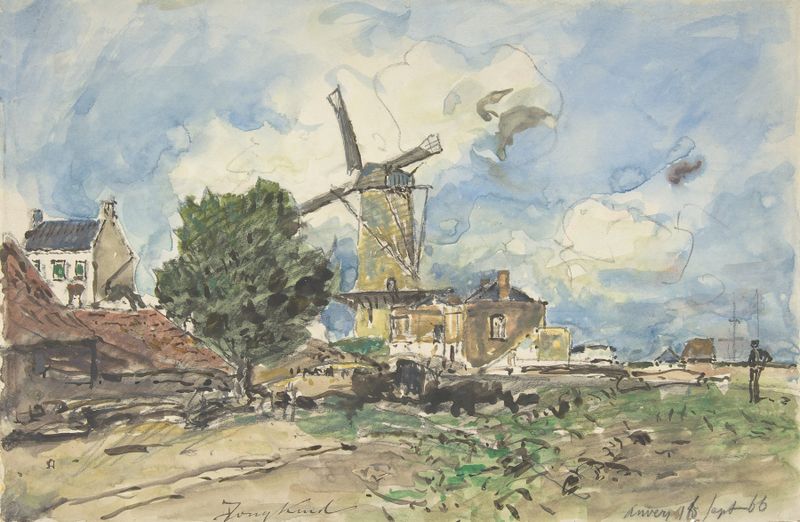
Wind Mill at Antwerp
Johan Barthold Jongkind

Le Havre
Johan Barthold Jongkind

The Church of Overschie
Johan Barthold Jongkind





