Forest — History & Facts
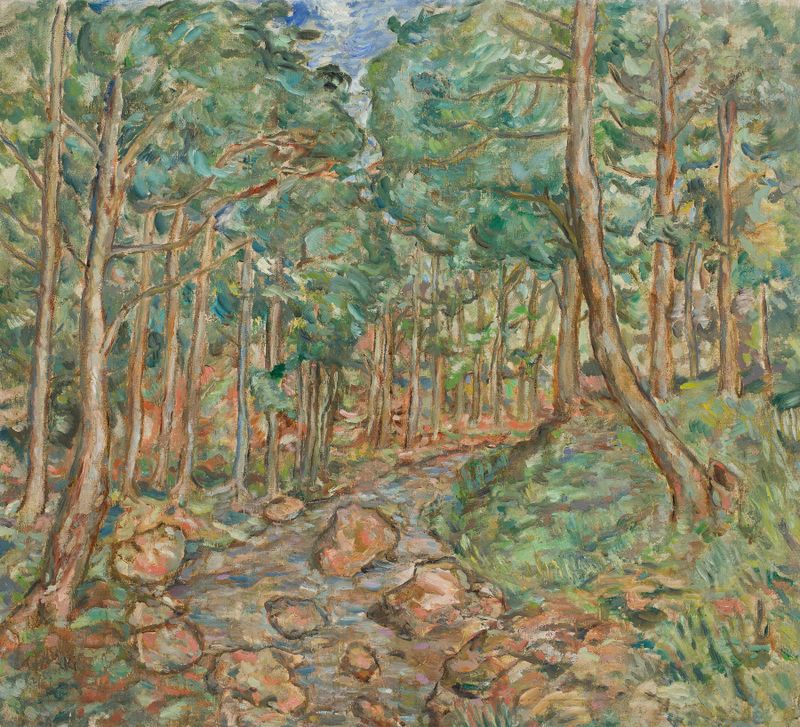
Can beauty exist without sorrow? In Forest, Tytus Czyżewski invites us to ponder the delicate interplay between joy and melancholy, illustrating a world where nature becomes a mirror of our own destinies. Look to the center of the canvas, where a vibrant explosion of greens and browns unfurls beneath a canopy of swirling, ethereal forms. The brushstrokes are both bold and fluid, creating a sense of movement that draws the eye deeper into the woodland's embrace. Notice how the dappled light filters through the trees, illuminating patches of earth in a way that brings the entire scene to life, each stroke resonating with a quiet, pulsating rhythm. As you linger, the tension within the exuberance becomes apparent.
The juxtaposition of the lively foliage against darker undertones hints at an underlying sorrow, a reminder that beauty often exists in the shadow of loss. Each tree stands tall yet solitary, suggesting the inevitability of change and the weight of time upon them — a poignant reflection of life's transience and our own destinies bound by nature’s cycles. Czyżewski painted Forest between 1934 and 1936, during a period of profound change in Poland and Europe at large. Emerging from the tumult of the interwar years, he sought to explore themes of identity and belonging through his art.
This work showcases his evolution as an artist, experimenting with color and form, while reflecting the complex emotional landscape of a world on the brink of turmoil.