
Forest Brook — History & Facts
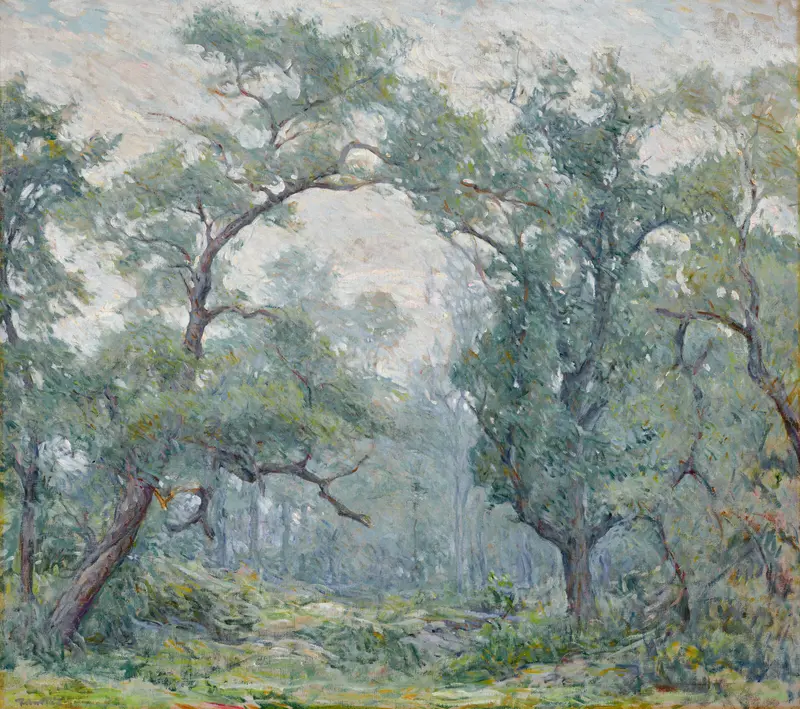
Focus on the gentle interplay of colors that create the illusion of movement in Forest Brook. The lush greens of the foliage seem to dance as light filters through the trees, while the water glistens, capturing reflections that are almost ethereal. Notice how the artist’s brushstrokes, seemingly spontaneous, weave a tapestry of texture and depth, drawing the viewer into a tranquil yet vibrant woodland scene. Hidden within this serene setting are contrasts that speak to the complexities of nature.
The fluidity of the brook represents both life and the passage of time, while the steady trunks of the trees stand as silent witnesses to the ever-changing landscape. Here, chaos and harmony coexist, and the viewer is reminded that beauty often arises from unexpected connections. The delicate balance of light and shadow further enhances this sense of unity, evoking a contemplative mood. During this period, Robert Reid was immersed in the American Impressionist movement, influenced by his explorations of color and form.
Working in the late 19th century, he sought to capture the essence of the American landscape, moving away from traditional representation to embrace a more subjective interpretation. The world was experiencing a shift towards modernism, and his work embodied the spirit of this transformation, reflecting both personal expression and a broader artistic evolution.
More Artworks by Robert Reid
More Landscape Art

The Starry Night
Vincent van Gogh

View of Delft
Johannes Vermeer

Water Lilies
Claude Monet

The Grand Canal, Venice, looking north-west from the Ca' Corner to the Ca' Contarini degli Scrigni, with the campanile of Santa Maria della Carità
Canaletto

Windsor Castle
Canaletto

The Grand Canal looking North-East from the Palazzo Dolfin-Manin to the Rialto Bridge
Canaletto