
Fort Union and Distribution of Goods to the Assiniboins — History & Facts
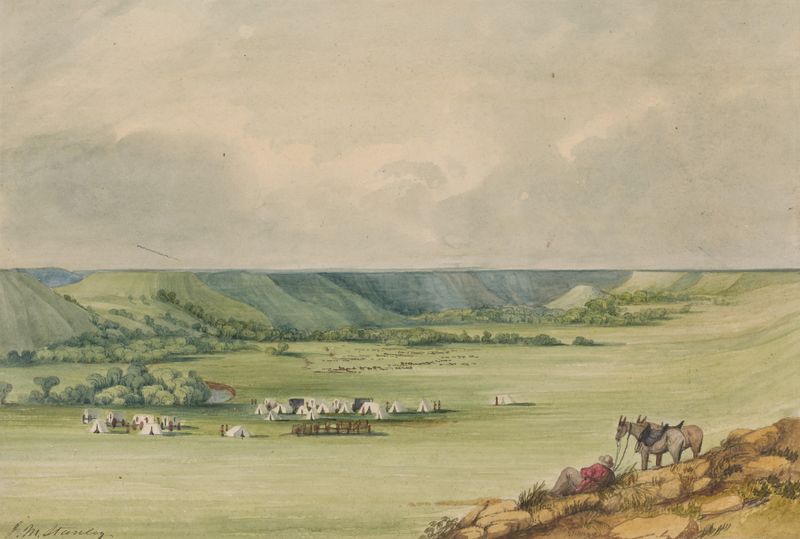
This thought echoes through the details of a scene where order and disorder collide, revealing the tenuous balance of existence. Even in the distribution of goods, civilization wrestles with the wildness of nature and the unpredictability of human interaction. Look to the foreground where figures, both Indigenous and European, gather around an assemblage of goods. The warm hues of ochre and umber dominate the palette, contrasting sharply with the refreshing greens of the surrounding landscape.
Notice how the light dances across the tents and glistens on the goods, lending a sense of vibrancy and urgency to the scene. The composition draws the eye to the central exchange, yet the surrounding figures reveal a broader narrative of connection, tension, and coexistence. Deeper still, examine the subtle expressions and postures of the participants. A furrowed brow here, a clenched fist there—each detail speaks to the unspoken anxieties of cultural exchange.
The meticulously rendered textures of the goods serve as a metaphor for the fraying relationships between two worlds, hinting at the madness of exploitation and the struggle for identity amidst a changing landscape. This tension illustrates the broader theme of survival in a rapidly modernizing frontier, where time itself feels precarious. In 1854, the artist worked on this painting amidst a burgeoning interest in the American West and its peoples. Living in Saint Louis, Stanley found himself at the nexus of east and west, influenced by an era defined by exploration and cultural collision.
As he captured the dynamics at Fort Union, he reflected the complexities of his time, a moment suspended between the promise of progress and the specter of upheaval.
More Artworks by John Mix Stanley
Browse all →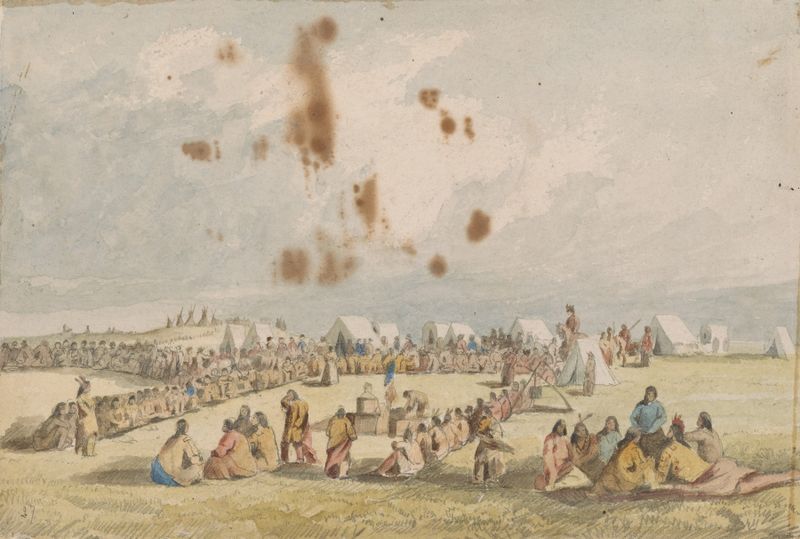
Distribution of Goods to the Assiniboins
John Mix Stanley
Flathead Lake, Looking toward the South
John Mix Stanley

A Morning in Milk River Valley
John Mix Stanley

Mount Rainier Viewed from Near Steilacoom
John Mix Stanley
Kettle Falls, Columbia River
John Mix Stanley

Pike Lake M.T.
John Mix Stanley
Sauk River
John Mix Stanley

Milk River – Bear’s Paw Mountain in Distance
John Mix Stanley

Fort Benton
John Mix Stanley
Sheyenne River
John Mix Stanley
More Historical Art
Browse all →
The Night Watch Militia Company of District II under the Command of Captain Frans Banninck Cocq
Rembrandt van Rijn

Lincoln Memorial
Henry Bacon

The Third of May 1808
Francisco de Goya

Isaac and Rebecca, Known as ‘The Jewish Bride’
Rembrandt van Rijn

The Charge of the Mamelukes (1814)
Francisco de Goya

De vier ruiters van de apocalyps
Albrecht Dürer