
Gezicht op Maassluis — History & Facts
Can paint confess what words never could? In Gezicht op Maassluis, the essence of emptiness hangs palpably in the air, a silent witness to life’s fleeting moments. Look to the left at the distant horizon where the sky meets the water, a soft gradient of blues and grays blending seamlessly to evoke an atmosphere of serenity. This quiet scene is punctuated by the gentle strokes that shape the boats, their stillness contrasting with the subtle ripples on the water’s surface. Notice how light diffuses across the canvas, casting a glow that imbues the entire setting with a contemplative stillness, revealing Jongkind's mastery of depicting nature’s quiet elegance. Beyond the tranquil water and muted sky lies an exploration of solitude and the passage of time.
The empty docks seem to echo a longing, each boat a fragment of stories untold. The sparse landscape invites introspection, creating a tension between what is seen and what remains unexpressed—an invitation to ponder life’s transience. The delicate balance between presence and absence is felt deeply, prompting the viewer to reflect on their own emotions and experiences. Painted in 1862, Jongkind crafted this piece during a time of personal and artistic evolution in the Netherlands.
Just as the art world was shifting towards Impressionism, he sought to capture the beauty of everyday scenes with a fresh perspective. Living in the wake of his studies in Paris, Jongkind found inspiration in the landscapes of his homeland, melding newfound techniques with deep-seated emotional truths.
More Artworks by Johan Barthold Jongkind
Browse all →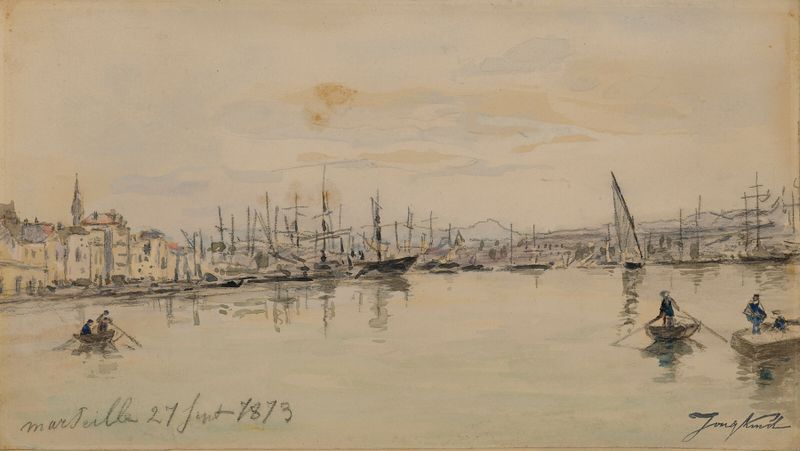
Le Port de Marseille
Johan Barthold Jongkind

Canal Saint-Martin
Johan Barthold Jongkind

Countryside near Brezins, between Grenoble and Vienne
Johan Barthold Jongkind

Notre-Dame vue du quai de la Tournelle
Johan Barthold Jongkind

Environs de Grenoble
Johan Barthold Jongkind

Clair de lune à Overschie (environs de Rotterdam)
Johan Barthold Jongkind

Port de Honfleur
Johan Barthold Jongkind
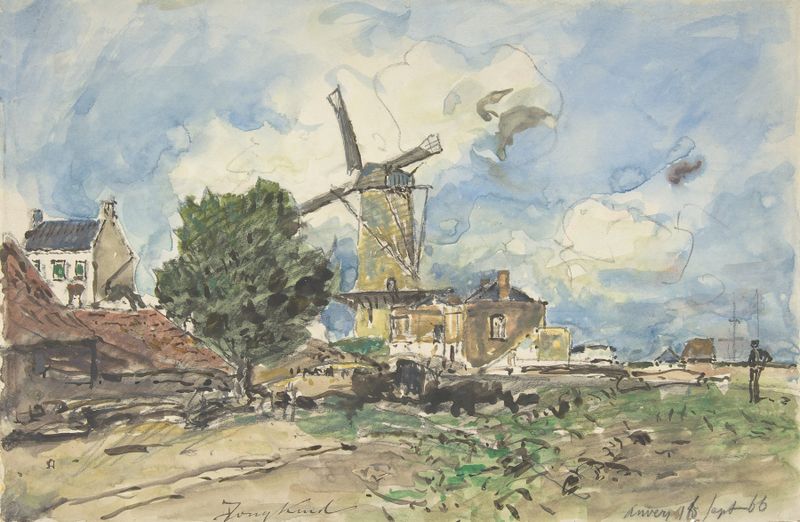
Wind Mill at Antwerp
Johan Barthold Jongkind

Le Havre
Johan Barthold Jongkind

The Church of Overschie
Johan Barthold Jongkind





