
Gillingham on the Medway — History & Facts
This delicate balance resonates through the contours of serene landscapes and the soft embrace of water. In a world often tumultuous, one seeks refuge in the calm that nature offers. Look to the foreground, where gentle ripples dance across the water's surface, reflecting a palette of muted blues and greens. Notice how the horizon stretches wide, merging the sky and river in a seamless gradient, inviting the viewer to breathe in the tranquility of the scene.
The soft brushwork evokes both clarity and a fleeting sense of nostalgia, drawing the eye into the depths of the composition where light and shadow play in harmony. Within this landscape lies a poignant contrast: the stillness of the water juxtaposed with the subtle presence of life along its banks. Two small boats linger, seemingly frozen in time, while nearby trees stand sentinel, their leaves whispering secrets of the past. This serenity is underscored by the absence of human figures, hinting at a deeper introspection — a reminder of the peaceful coexistence between humanity and nature. In the artist's life, this work emerged during a time of personal transition, when he was capturing the beauty of the English landscape in the mid-19th century.
Living in a world where the Industrial Revolution was reshaping the environment and society, he found solace in the natural world. His dedication to plein air painting sought to immortalize these fleeting moments of serenity, revealing both the changing landscapes and the unchanging truths they hold.
More Artworks by William James Müller
Browse all →
Cleeve, Somerset, with Bridgewater Bay in the Distance
William James Müller

The Bridge at Llangollen
William James Müller

Cairo Bazaar
William James Müller
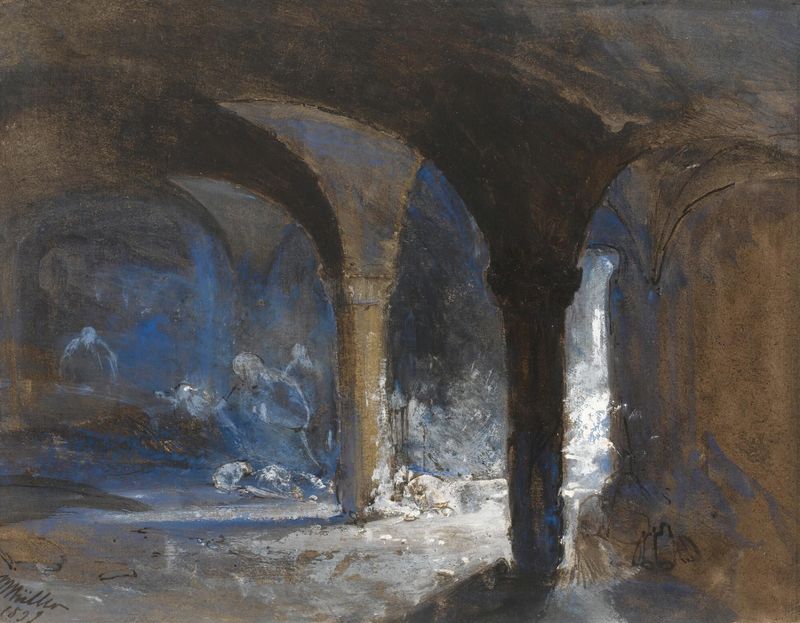
Crypt of the bishop’s palace during the Bristol riots
William James Müller

Near the Caravan Bridge, Smyrna
William James Müller

The Church of the Holy Sepulchre
William James Müller

A View of Eton and the Fellows Eyot
William James Müller

Tripoli
William James Müller

A Mountain Torrent
William James Müller

Gezicht in Stapleton Wood, bij Bristol
William James Müller





