
The Church of the Holy Sepulchre — History & Facts
In the stillness of a sacred space, echoes of betrayal linger, entangled with whispers of reverence and loss. This painting draws us into the heart of a historical and emotional crossroads, where faith and disillusionment coexist in haunting harmony. Focus first on the architecture, a grand tapestry of stone and shadow that looms above the scene. The Church of the Holy Sepulchre stands as a testament to both devotion and conflict, each arch and column intricately detailed and bathed in a warm, golden light that highlights their textures.
Notice how the artist employs a muted palette, reflecting the somber nature of the subject, yet allowing flecks of brilliance to emerge through the interplay of light and shadow, suggesting the weight of history embedded within its walls. Betrayal emerges in the juxtaposition of the serene beauty of the church against the turmoil of its past. The soft glow of candlelight contrasts sharply with the darkened corners, indicating secrets that lie within, hinting at the trials faced by those who sought solace here. The viewer is drawn to the delicate brushstrokes that convey both reverence and despair, a reminder of the countless souls who have both worshiped and suffered in this space. William James Müller painted this work between 1838 and 1840 during a time of personal and artistic upheaval in his life.
Deeply engaged with the Romantic movement, he traveled extensively in Europe, capturing spiritual and historical themes through his art. The era was marked by a burgeoning interest in authenticity and emotional depth, reflective of a world grappling with change and the weight of history.
More Artworks by William James Müller
Browse all →
Cleeve, Somerset, with Bridgewater Bay in the Distance
William James Müller

The Bridge at Llangollen
William James Müller

Cairo Bazaar
William James Müller
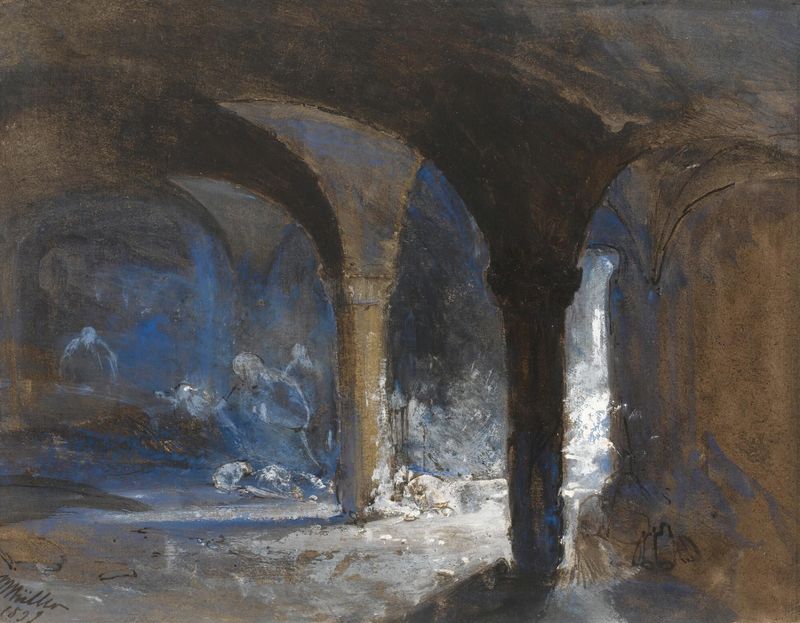
Crypt of the bishop’s palace during the Bristol riots
William James Müller

Near the Caravan Bridge, Smyrna
William James Müller
Gillingham on the Medway
William James Müller

A View of Eton and the Fellows Eyot
William James Müller

Tripoli
William James Müller

A Mountain Torrent
William James Müller

Gezicht in Stapleton Wood, bij Bristol
William James Müller
More Architecture Art
Browse all →
The statue of Liberty
Frédéric Auguste Bartholdi

View of Houses in Delft, Known as ‘The Little Street’
Johannes Vermeer

View of Houses in Delft, Known as ‘The Little Street’
Johannes Vermeer

The Cathedral in Rouen. The portal, Grey Weather
Claude Monet

The yellow house
Vincent van Gogh

The Church in Auvers-sur-Oise, View from the Chevet
Vincent van Gogh