
Crypt of the bishop’s palace during the Bristol riots — History & Facts
Can beauty exist without sorrow? In Crypt of the bishop’s palace during the Bristol riots, the contrast between turmoil and tranquility invites contemplation on the nature of transcendence amidst chaos. Look to the center of the canvas, where the soft, flickering light from a distant lantern illuminates the crypt’s ancient stone. Notice how the artist employs a muted palette, with deep browns and mossy greens, to convey the weight of history and the shadows of conflict. The interplay of light and dark is masterful, drawing the viewer’s eye to the solemn figures huddled together, their postures tense yet restrained, evoking a sense of shared fear and solidarity. Delve deeper into the composition, and you will spot subtle gestures—a hand clasped in prayer, a face turned away in despair.
These small details resonate with the larger narrative of social unrest, suggesting that even in times of violence, there is a yearning for peace and reflection. The juxtaposition of the crypt's timeless sanctuary against the turmoil outside becomes a powerful metaphor for resilience and hope, inviting viewers to contemplate the enduring human spirit. William James Müller created this work in 1832, during a period of significant civil unrest in Britain, exemplified by the Bristol riots. He was living in a time marked by industrial change and socio-political upheaval, which deeply influenced his artistic perspective.
This piece reflects not only his technical mastery but also his engagement with the tumultuous world around him, capturing the essence of a moment where the sanctity of space stands in stark contrast to the chaos beyond its walls.
More Artworks by William James Müller
Browse all →
Cleeve, Somerset, with Bridgewater Bay in the Distance
William James Müller

The Bridge at Llangollen
William James Müller

Cairo Bazaar
William James Müller

Near the Caravan Bridge, Smyrna
William James Müller
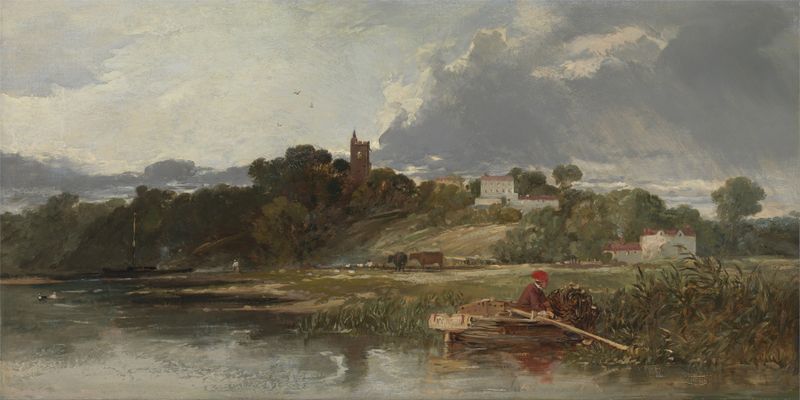
Gillingham on the Medway
William James Müller

The Church of the Holy Sepulchre
William James Müller

A View of Eton and the Fellows Eyot
William James Müller

Tripoli
William James Müller

A Mountain Torrent
William James Müller

Gezicht in Stapleton Wood, bij Bristol
William James Müller
More Historical Art
Browse all →
The Night Watch Militia Company of District II under the Command of Captain Frans Banninck Cocq
Rembrandt van Rijn

Lincoln Memorial
Henry Bacon

The Third of May 1808
Francisco de Goya

Isaac and Rebecca, Known as ‘The Jewish Bride’
Rembrandt van Rijn

The Charge of the Mamelukes (1814)
Francisco de Goya

De vier ruiters van de apocalyps
Albrecht Dürer