Golden Sunset — History & Facts
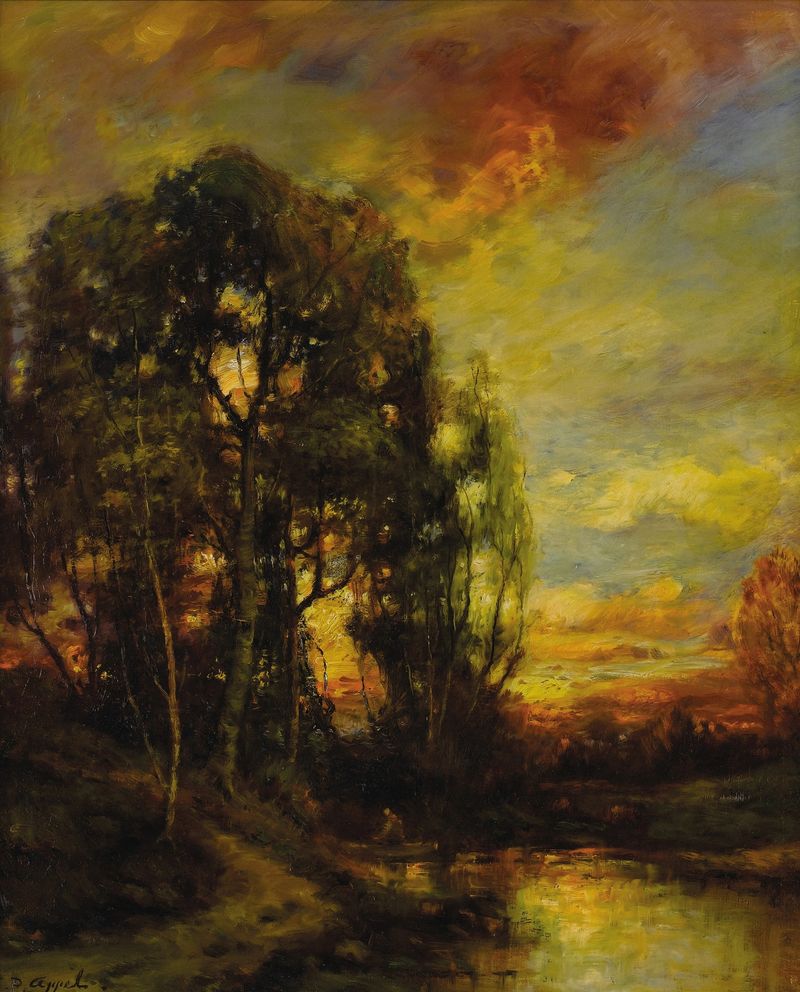
Can paint confess what words never could? Golden Sunset beckons viewers to explore the delicate interplay between fleeting beauty and the madness of an uncertain world. Look to the left at the rich oranges and deep golds that meld seamlessly into the horizon, where the sun descends, casting a warm glow over the landscape. The brushstrokes evoke fluid motion, inviting your eyes to dance across the canvas. Notice how the fading light weaves through the wispy clouds, the colors becoming more vibrant as they edge closer to dusk.
The composition captures an idyllic serenity, yet the swirling patterns in the sky hint at the chaos lurking just beyond the frame. Beneath the tranquil facade lies a tension that speaks to the turbulence inherent in change. The vibrancy of the sunset is juxtaposed with darkness encroaching at the canvas's edges, suggesting a psyche on the brink of unraveling. The colors pulse with an energy that hints at both longing and despair, mirroring the delicate balance between peace and madness.
Each brushstroke serves as a whisper of unspoken thoughts, echoing the emotional turmoil that often accompanies beauty. Created during a time of personal reflection and exploration, the artist crafted this piece in an era when impressionism was gaining momentum. The late 19th century saw a shift towards capturing transient moments in art, and for Charles P. Appel, this piece is emblematic of his quest to embody the essence of the world around him.
Engaging deeply with the interplay of light and color, he sought to convey not just a scene, but a visceral experience that resonates with the viewer long after they part with the canvas.