
Haagse Veere, Rotterdam — History & Facts
Did the painter know this moment would outlive them? The vibrancy of color in Haagse Veere, Rotterdam beckons us to ponder the fleeting yet eternal nature of light and landscape. Focus on the gentle strokes of azure and emerald that merge sky and water, drawing your eye to the shimmering reflections. Notice how the deft application of paint transforms a simple scene into a dance of hues — the cool blues balancing the warmth of the sunlit yellows and ochres. The composition is anchored by a distant horizon, inviting the viewer to wander into a world where land and sea converge in harmony. Beneath the apparent serenity lies a story of contrast — between the stillness of the water and the bustling activity of life along the shore.
Each brushstroke carries whispers of history: the vibrancy of the port bustling with trade, and the soft edges of the landscape hinting at nature's resilience. This duality evokes feelings of nostalgia and contemplation, as if the painting captures an ideal moment while also reflecting the relentless passage of time. In 1856, Johan Barthold Jongkind had settled in France after moving from the Netherlands, where the art world was shifting towards Impressionism. His experimentation with light and color in Haagse Veere, Rotterdam marked a transition in his style, reflecting his desire to break free from the confines of traditional landscapes.
At this time, he was deeply influenced by contemporaries such as Eugène Boudin and Claude Monet, exploring the interplay between nature and the human experience.
More Artworks by Johan Barthold Jongkind
Browse all →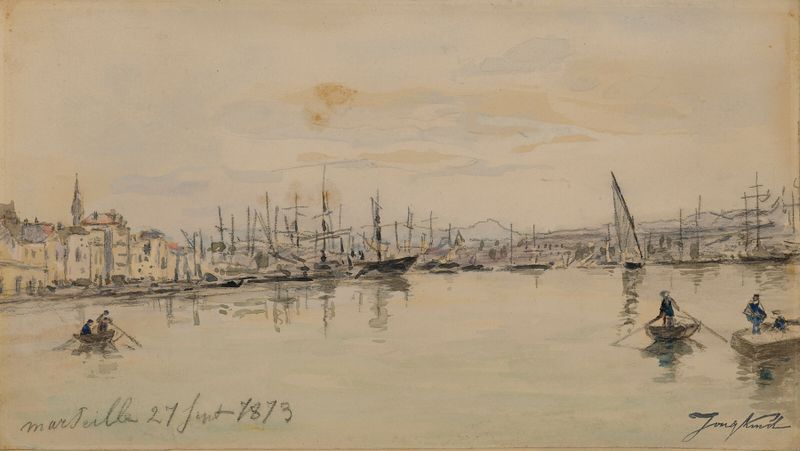
Le Port de Marseille
Johan Barthold Jongkind

Canal Saint-Martin
Johan Barthold Jongkind

Countryside near Brezins, between Grenoble and Vienne
Johan Barthold Jongkind

Notre-Dame vue du quai de la Tournelle
Johan Barthold Jongkind

Environs de Grenoble
Johan Barthold Jongkind

Clair de lune à Overschie (environs de Rotterdam)
Johan Barthold Jongkind

Port de Honfleur
Johan Barthold Jongkind
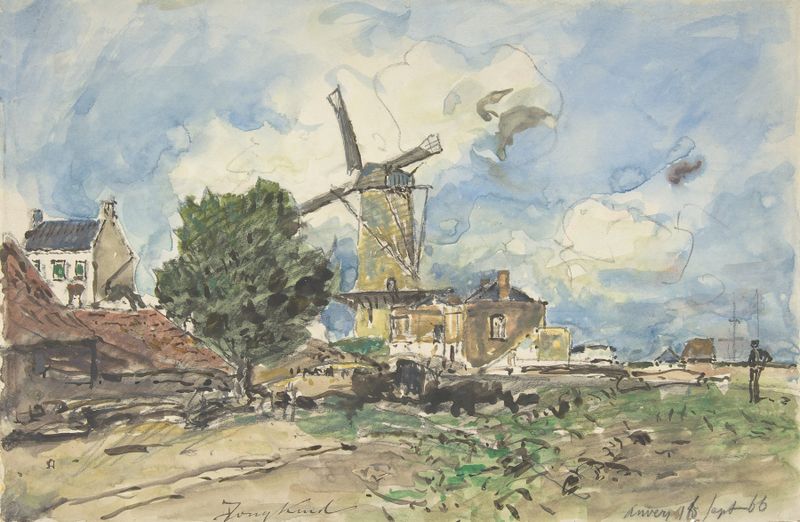
Wind Mill at Antwerp
Johan Barthold Jongkind

Le Havre
Johan Barthold Jongkind

The Church of Overschie
Johan Barthold Jongkind





