Harvest on the Roman Campagna — History & Facts
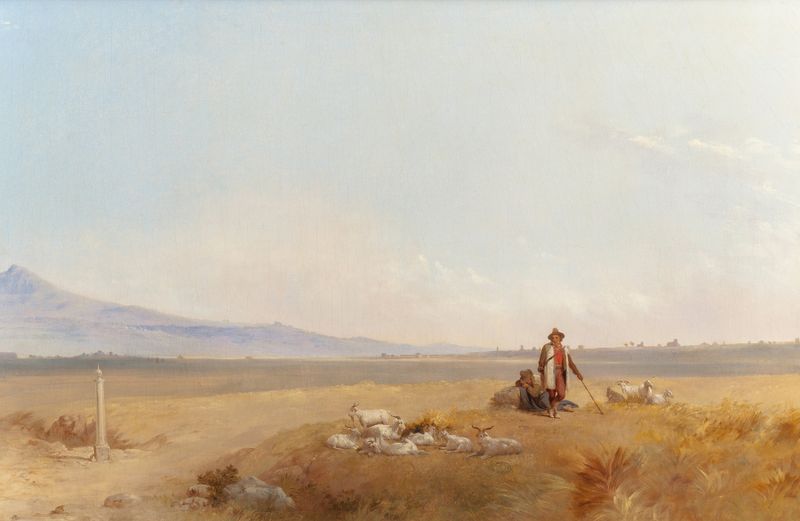
In the delicate play of shadow and light, Harvest on the Roman Campagna invites us to reflect on fleeting moments of labor and life itself. Look to the center of the canvas, where figures bend under the weight of golden bundles, their postures a testament to toil and resilience. Notice the rich, earthy tones that dominate the foreground, contrasting with a luminous sky that spills warm light over the scene. The composition draws your eye towards the horizon, where gentle hills recede into dream-like blue, suggesting the endless cycle of nature and human effort.
Shadows stretch long behind the workers, hinting at the ephemeral nature of their labor and the passage of time. Yet within this idyllic setting lies a tension. The vibrant colors evoke a sense of abundance, while the shadows signal the inevitable approach of evening—a reminder that even the sunniest days must yield to darkness. The juxtaposition of human effort against the vastness of the Campagna landscape speaks volumes about the transient nature of existence.
Each figure, though united in their task, appears isolated in their thoughts, lost in a moment that will soon slip into memory. In 1868, John Gadsby Chapman painted this piece during a period of significant change in the art world, as realism began to rise alongside romanticism. Living in America but inspired by European landscapes, he sought to capture the essence of labor and the beauty of the land. This work reflects a time when artists were increasingly drawn to the everyday lives of people, blending academic techniques with a newfound appreciation for the soulful details of their subjects.