
Heimkehrende Truppen vor den Toren der Stadt — History & Facts
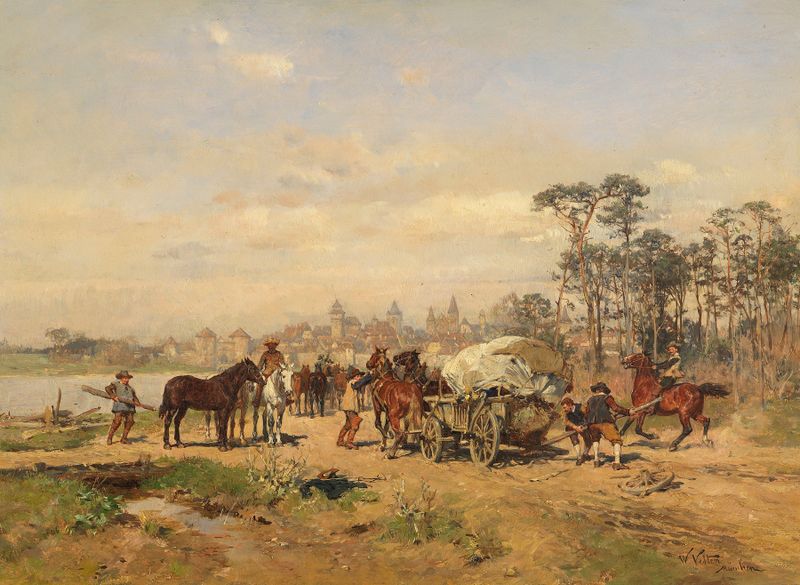
In the quiet heaviness of this moment, fragility lingers, demanding recognition of the heart's unspoken truths. The weight of returning troops, their faces etched with experiences both harrowing and hopeful, embodies more than just military triumph; it speaks to the human spirit's vulnerability. Focus on the figures in the foreground, where weary soldiers emerge from the hazy distance. Their postures are a mix of pride and exhaustion, each one a testament to survival amidst uncertainty.
Notice how the muted palette complements the somber atmosphere, while the faint gold of the setting sun casts long shadows, enhancing the emotional depth of this scene. The composition invites you to explore the tension between the strength of the unified group and the individual fragility each soldier carries. As you delve deeper, consider the expressions that tell a story of loss and resilience. The slight tremor in a soldier’s hand, the longing gaze of a comrade, and the distant blurred outline of the city gates all converge, symbolizing not just a return, but a confrontation with what has been left behind.
This piece encapsulates the duality of victory—a moment of relief intertwined with the haunting echoes of sacrifice. Wilhelm Velten painted Heimkehrende Truppen vor den Toren der Stadt between 1880 and 1890, during a period of shifting political landscapes in Europe. As nations grappled with the aftermath of conflicts, Velten's work reflects the societal need to process the tumultuous realities of war. Living and working in an era focused on realism, he sought to capture the authentic emotions of his subjects, lending his paintings a profound sense of connection to the human experience.
More Artworks by Wilhelm Velten
Browse all →

More Historical Art
Browse all →
The Night Watch Militia Company of District II under the Command of Captain Frans Banninck Cocq
Rembrandt van Rijn

Lincoln Memorial
Henry Bacon

The Third of May 1808
Francisco de Goya

Isaac and Rebecca, Known as ‘The Jewish Bride’
Rembrandt van Rijn

The Charge of the Mamelukes (1814)
Francisco de Goya

De vier ruiters van de apocalyps
Albrecht Dürer