Herd of Horses on the Puszta — History & Facts
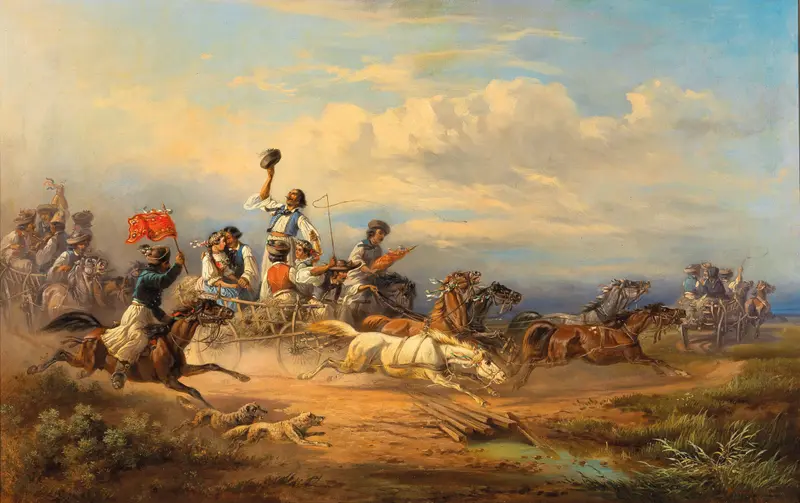
What first seizes the eye in Herd of Horses on the Puszta is the sense of wild momentum, as if the entire plain has been set in motion by the thundering hooves and the whip of the herdsman. The horses surge forward in a rolling wave, their bodies stretched and muscles taut, while the rider at the left, arm raised in a sweeping arc, directs the chaos with a lasso poised mid-air. The clouds above echo the drama below, billowing and breaking with light that falls in patches across the scene, lending a restless energy to both sky and earth.
The palette, dominated by earthy browns and cool blues, grounds the action in the open sweep of the Hungarian plain, where even the distant huts and low horizon seem to bow before the stampede. Painted in 1858, this work belongs to a tradition that celebrated the untamed landscapes and spirited animal life of Central Europe—a world rapidly changing under the pressures of modernization. Such images were prized by collectors eager for visions of a vanishing rural past, and artists like Adolf van der Venne found their subjects in the drama of daily labor and the freedom of the open steppe. The Puszta, Hungary’s great plain, was legendary for its herds and horsemen, and scenes like this offered urban viewers a taste of its mythic vitality.
Though little is recorded about this particular painting’s early journey, its presence today in a 19th-century painting auction invites us to linger over the details: the flash of a pheasant in the grass, the tension in the horses’ necks, the vast sky that makes every figure seem both small and heroic.