
Wilde Fahrt — History & Facts
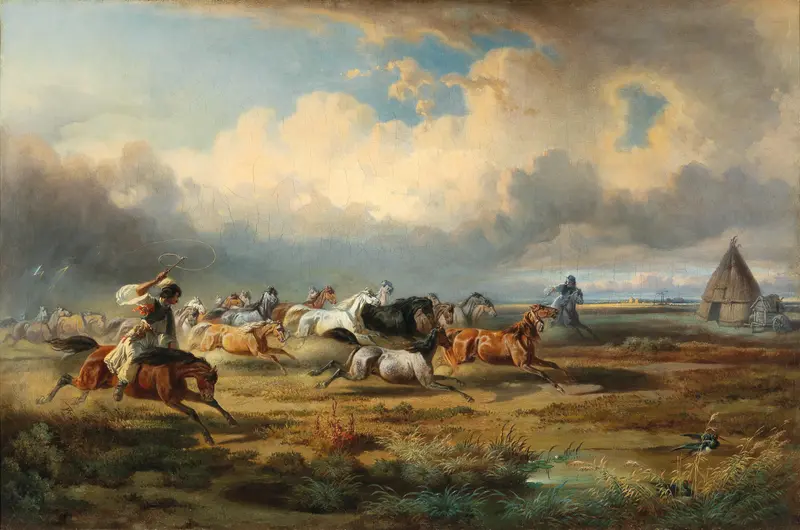
The first thing that seizes the eye in Wilde Fahrt is its wild, tumbling energy—a convoy of horses and carriages thundering across the open plain, dust billowing in their wake, as if the whole world has been swept into a festival charge. The artist, Adolf van der Venne, orchestrates this chaos with a conductor’s hand: a rider at the front waves a crimson banner, while another figure, standing tall in his cart, lifts his hat high in exuberant salute. The horses, rendered with taut muscles and flaring nostrils, seem barely restrained by their drivers, and the crowding of figures—men, women, even dogs swept along—turns the scene into a communal spectacle.
The palette is bright and sunlit, the sky vast, amplifying the sense of freedom and motion, while the details—the ribbons on the horses, the flowers in the women’s hair—hint at celebration, perhaps a wedding or a village holiday, though the true occasion remains locked in the artist’s brushwork. Created in 1856, this painting belongs to a world where such scenes were both real and mythologized. The mid-19th century saw a flourishing of genre painting across Central and Eastern Europe, with artists capturing the customs, costumes, and communal life of rural societies on the cusp of modernity. Works like Wilde Fahrt were often bought by urban collectors nostalgic for a vanishing folk world, or by those eager to display the vigor and color of their national traditions.
Little is recorded about this particular painting’s early journey, but its presence today in the Dorotheum’s collection is a testament to the enduring appeal of such lively, detailed storytelling. The longer you look, the more you sense the pulse of a vanished countryside—one that gallops, laughs, and sings across the canvas.
More Artworks by Adolf van der Venne

More Genre Scene Art

Banquet of the Officers of the St George Civic Guard
Frans Hals

Rembrandt and Saskia in the Scene of the Prodigal Son
Rembrandt van Rijn

Bal du moulin de la Galette
Pierre-Auguste Renoir

Quadrille at the Moulin Rouge
Henri de Toulouse-Lautrec

A Burial at Ornans
Gustave Courbet

When Will You Marry?
Paul Gauguin