Hill And Marshland — History & Facts
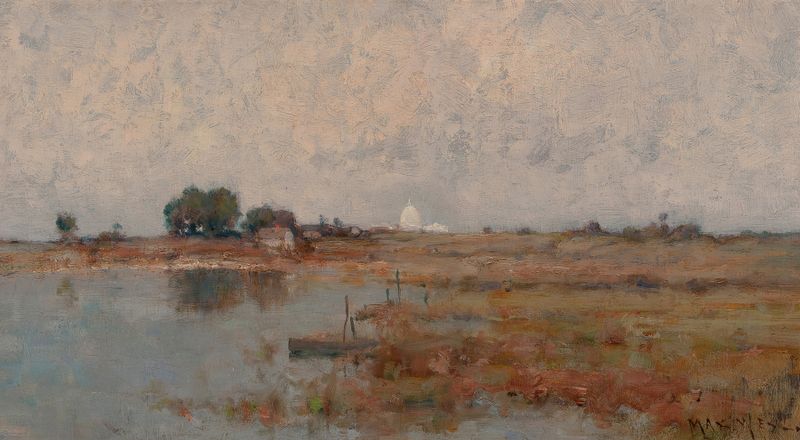
Who listens when art speaks of silence? In Hill and Marshland, light becomes a language all its own, whispering the stories of nature in hues of tranquility and depth. Look to the horizon, where rolling hills meet the expansive marshland, bathed in a soft, pinkish glow. The gentle gradient of colors reflects a setting sun, illuminating the soft contours of the land. Your eyes might be drawn first to the interplay of light and shadow on the grassy knolls, which seem to breathe with life despite their stillness.
The brushwork is deft yet deliberate, allowing the textures of the terrain to emerge, inviting you to touch the painting, to feel the cool air that seems to linger there. As the eye travels through the scene, subtle contrasts begin to unfold. The vibrant flora in the foreground stands in stark juxtaposition to the muted tones of the marshland, representing the tension between vibrancy and desolation. Each element holds a story, whether it's the quiet resilience of the grass or the enigmatic marsh waters reflecting the encroaching dusk.
Together, these contrasts create a dialogue of stillness and movement, allowing the viewer to ponder the transience of nature and the enduring presence of light. Max Weyl created this captivating piece during a period of remarkable transition in the art world, though its precise date remains a mystery. Active in the late 19th to early 20th centuries, he was influenced by the impressionist movement, which sought to capture fleeting moments and the effects of light. At that time, artists were increasingly exploring the natural world, and Weyl, with his distinctive approach to color and form, contributed to this collective conversation about the beauty found in quiet landscapes.