
Hooiwagen bij een boerderij 021872 Stedelijk Museum Alkmaar — History & Facts
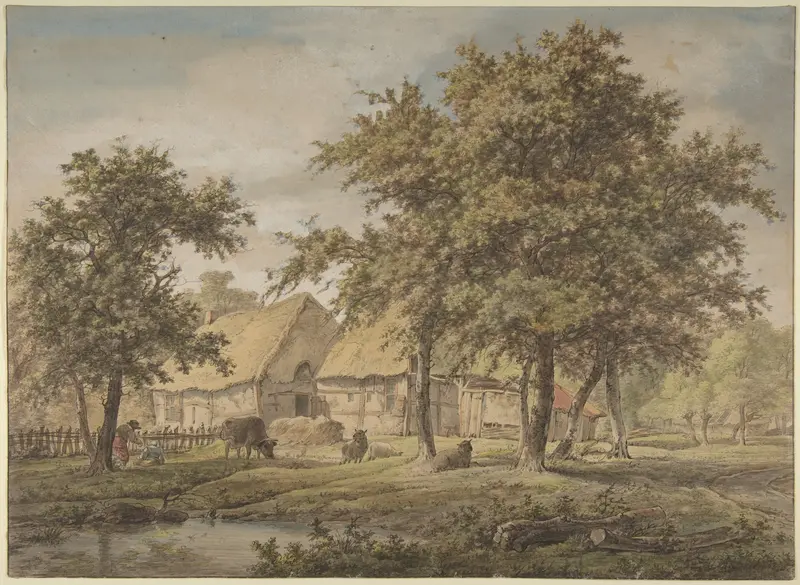
A quiet sense of labor fills this rural scene, where the eye is gently led from the tangled branches of a foreground tree to the sunlit thatched roofs beyond. The hay wagon, loaded high and drawn by a patient horse, anchors the composition—its cargo a testament to the season’s work. A figure atop the mound of hay pauses, while another, below, stands in conversation, her red skirt catching the light and drawing us into the human rhythm of the day.
Sheep graze in the shade, and the long shadows suggest the waning afternoon. The artist’s careful modulation of greens and golds creates a mood of calm industry, as if the landscape itself is quietly sustaining those who live upon it. Painted between circa 1785 and 1825, this work by Adrianus de Visser belongs to a tradition that flourished in the Dutch countryside, where scenes of everyday rural life were prized for their sense of order and harmony. Such paintings were often collected by city dwellers nostalgic for the rhythms of the land, or by local patrons keen to celebrate their own surroundings.
Today, the painting is held in the Stedelijk Museum Alkmaar, a reminder of the enduring appeal of the Dutch landscape and the quiet dignity of its workers. Look again at the play of light on the wagon and the careful tilt of each tree—every detail is an invitation to linger.
More Artworks by Adrianus de Visser
More Landscape Art

The Starry Night
Vincent van Gogh

View of Delft
Johannes Vermeer

Water Lilies
Claude Monet

The Grand Canal, Venice, looking north-west from the Ca' Corner to the Ca' Contarini degli Scrigni, with the campanile of Santa Maria della Carità
Canaletto

Windsor Castle
Canaletto

The Grand Canal looking North-East from the Palazzo Dolfin-Manin to the Rialto Bridge
Canaletto