
Hospital of Brooklyn — History & Facts
When did color learn to lie? The hues of a once-vibrant life can mask the stark realities of suffering and healing, weaving a narrative deeper than the canvas itself. Look to the left at the imposing structure of the hospital, its façade an unsettling blend of warm and cool tones that evoke both comfort and foreboding. Notice how the intricate detailing of the windows draws the eye upward, leading us to the sky—a battleground of swirling greys and hopeful blues. The brushwork pulsates with energy, each stroke narrating the struggle between despair and resilience, while the surrounding landscape seems to hold its breath, accentuating the gravity of the moment. Here lies a complex emotional tapestry; the hospital signifies both refuge and confinement, a duality that resonates with the viewer.
The shadows cast across the entrance tell of those who linger at the thresholds of life, their stories intertwined with that of the building. This juxtaposition of hope and challenge is palpable in the sterile yet symmetrical layout, where the human spirit grapples with vulnerability amidst the architectural strength. In 1850, at a time when medical advancements were still in their infancy, the artist painted Hospital of Brooklyn in New York City. The burgeoning field of public health was beginning to take shape, as cities recognized the necessity of such institutions.
Autenrieth, influenced by the social conditions of his time, crafted this piece not merely as an artistic endeavor but as a commentary on the intertwined fates of medicine, society, and the human experience.
More Artworks by Charles Autenrieth
Browse all →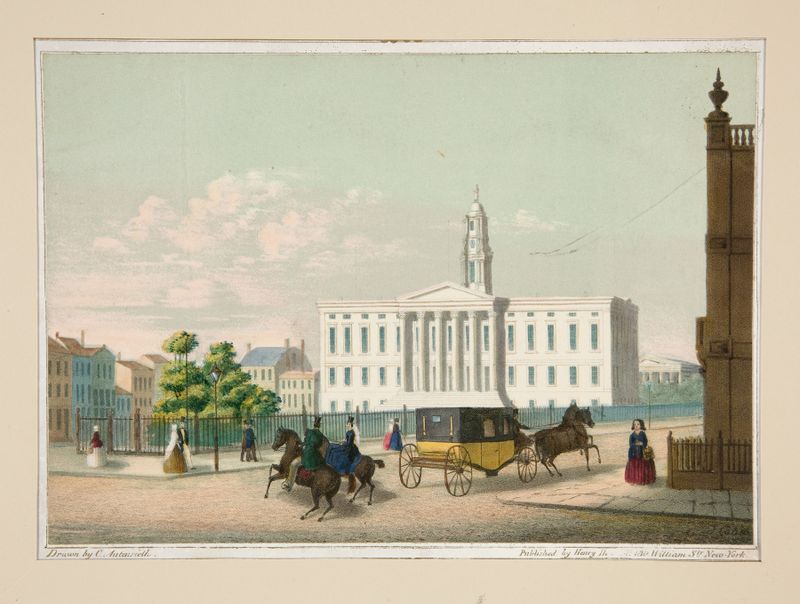


More Architecture Art
Browse all →
The statue of Liberty
Frédéric Auguste Bartholdi

View of Houses in Delft, Known as ‘The Little Street’
Johannes Vermeer

View of Houses in Delft, Known as ‘The Little Street’
Johannes Vermeer

The Cathedral in Rouen. The portal, Grey Weather
Claude Monet

The yellow house
Vincent van Gogh

The Church in Auvers-sur-Oise, View from the Chevet
Vincent van Gogh