
Trinity Church — History & Facts
Could beauty survive in a century of chaos? In Trinity Church, the answer unfolds through a serene yet powerful image of architectural elegance standing resilient against the passage of time. It whispers of faith, community, and the human spirit’s quest for permanence amid an ever-changing world. Focus first on the towering spire that reaches skyward, framed by a soft blue sky bathed in warm sunlight. The meticulous brushwork reveals the intricate details of the church's façade, inviting the viewer to explore its arches and decorative elements.
Notice how light dances across the stone, casting gentle shadows that enhance the structure's depth and solidity. The subtle earth tones of the surrounding landscape serve as a grounding backdrop, emphasizing the church’s dignified presence. As you delve deeper, consider the juxtaposition of the church against the backdrop of modernity slowly encroaching upon the pastoral scene. The warm, inviting hues evoke a sense of comfort and safety, while the looming shadows hint at change and uncertainty.
This duality speaks to the tension between tradition and progress, a dialogue that resonates through the ages. Each brushstroke reflects not just a building but a sanctuary—both literal and metaphorical—offering refuge from the chaos of the outside world. Created in 1850, this work emerged during a time of significant transformation in America, as urbanization and industrialization began to reshape landscapes and lives. Charles Autenrieth, settled in New York, found inspiration in the architectural beauty that defined the city’s skyline.
His dedication to capturing the essence of such structures reflects a crucial moment in art, where the old ways of life began to clash with the new, allowing for a profound exploration of time, identity, and belonging.
More Artworks by Charles Autenrieth
Browse all →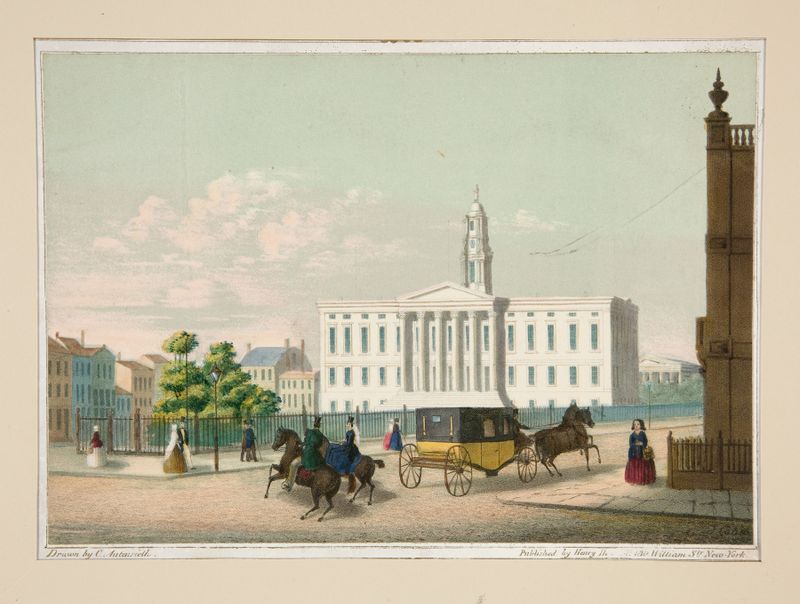


More Architecture Art
Browse all →
The statue of Liberty
Frédéric Auguste Bartholdi

View of Houses in Delft, Known as ‘The Little Street’
Johannes Vermeer

View of Houses in Delft, Known as ‘The Little Street’
Johannes Vermeer

The Cathedral in Rouen. The portal, Grey Weather
Claude Monet

The yellow house
Vincent van Gogh

The Church in Auvers-sur-Oise, View from the Chevet
Vincent van Gogh