
How we lost poor Flossie — History & Facts
In How we lost poor Flossie, the canvas captures the haunting essence of obsession, drawing us into a world of longing and loss. Look to the foreground, where a young woman reclines against a vibrant floral backdrop. Her attire, a soft blend of earthy tones, contrasts with the vivid greens and reds surrounding her, signifying a struggle between internal desires and external distractions. The brushwork is fluid, almost dreamlike, guiding the viewer’s eye toward her distant gaze — a reflection of her inner turmoil, as if she were caught between two worlds: the one she inhabits and the elusive dreams that beckon her. The composition speaks volumes about obsession's dual nature.
Notice the subtle tension in her expression, a blend of serenity and sorrow, hinting at a deeper narrative. The vibrant flowers are not mere decoration; they symbolize the fleeting nature of beauty and the dangers of fixation. This duality invites contemplation on how obsession can lead to both inspiration and despair. In 1889, Charles Conder was in Australia, where he created this piece amidst the burgeoning Impressionist movement.
As he explored the nuances of color and light, he was also grappling with his own artistic identity, reflecting the tumultuous changes in his life and the art world around him. This work stands as a testament to that period, embodying the tension between personal struggle and the quest for artistic expression.
More Artworks by Charles Conder
Browse all →
On the River Yarra, near Heidelberg, Victoria
Charles Conder
Rickett’s Point
Charles Conder

Sunset, Sydney Harbour
Charles Conder

Australian landscape
Charles Conder

Riddell’s Creek
Charles Conder
Under a southern sun
Charles Conder
Ricketts Point, Beaumaris
Charles Conder

Going home
Charles Conder
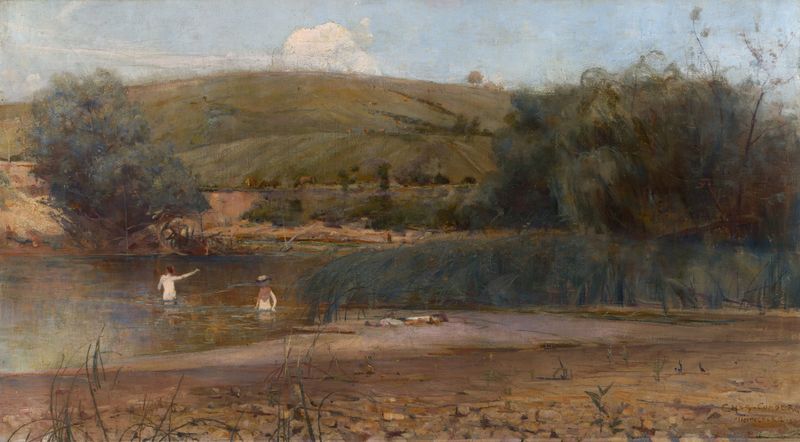
The Yarra, Heidelberg
Charles Conder
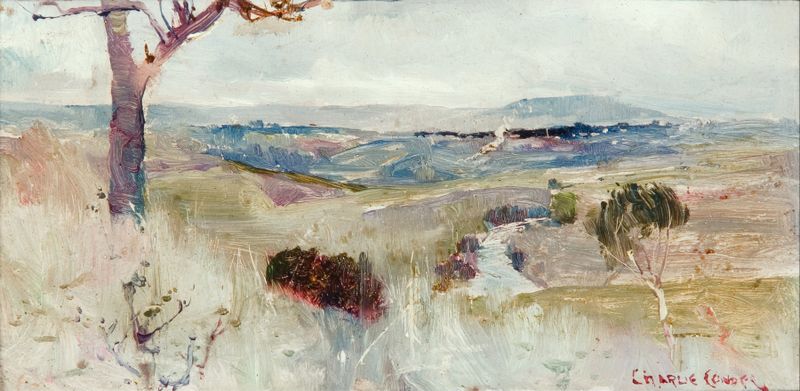
Dandenongs from Heidelberg
Charles Conder
More Portrait Art
Browse all →
Las meninas
Diego Velázquez

Self-portrait with a Bandaged Ear and Pipe
Unidentified artist

Girl with a Pearl Earring
Johannes Vermeer

The Sampling Officials of the Amsterdam Drapers’ Guild, Known as ‘The Syndics’
Rembrandt van Rijn

The Hundred Guilder Print: the man seen on the back in the lower left corner
Rembrandt van Rijn

Portrait of Dr Gachet
Vincent van Gogh