
Hütte auf der Waucha-Alm — History & Facts
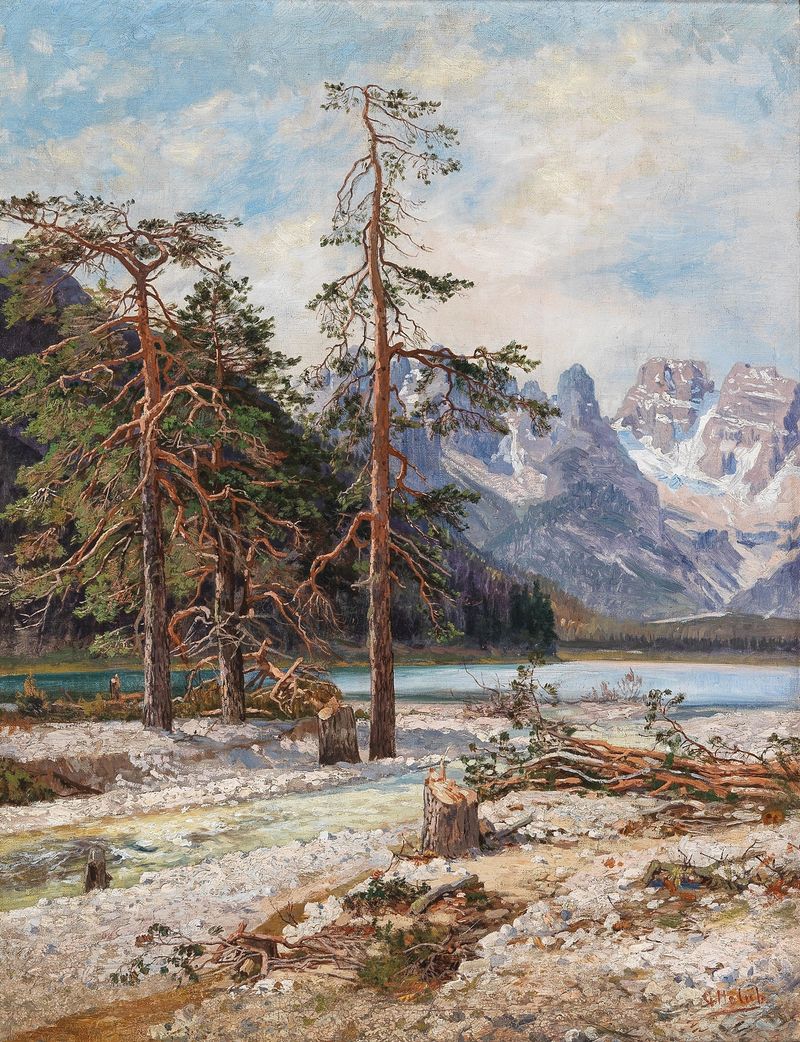
When did color learn to lie? The hues that dance across the canvas whisper secrets of longing and nostalgia, inviting us to question the nature of our own memories. Focus on the tranquil peaks that tower in the background, their gray and blue tones weaving a somber silhouette against the vibrant, warm colors of the foreground. Notice how the delicate brushstrokes create the texture of the wooden cabin, inviting the viewer into a rustic embrace. The gentle play of light hints at the sun's descent, casting a golden glow that contrasts starkly with the encroaching shadows, revealing the artist's mastery of capturing time's fleeting nature. Within the serene landscape lies a poignant tension between solitude and the warmth of home.
The cabin, nestled among the expansive wilderness, evokes feelings of melancholy—it stands as a refuge, yet also as a reminder of isolation. The color palette, a blend of vibrant warmth and cool desolation, emphasizes the duality of comfort and loneliness, inviting introspection about the spaces we inhabit and the emotions they harbor. Created in 1910, this work emerged during a period of immense change in Europe. Holub painted it while grappling with the aftereffects of industrialization and the rise of modernism, which challenged traditional perspectives on art and nature.
Against this backdrop, the piece reflects both a longing for simpler times and an awareness of the inevitable march of progress, encapsulating the artist's own search for meaning amidst shifting landscapes.
More Artworks by Georg Holub
Browse all →
Mühle am Bachufer
Georg Holub

Shore at Ragusa
Georg Holub

Buchenwald am Abend, Motiv aus Krain
Georg Holub

A Roaring Waterfall
Georg Holub

Winter im Rosenthal bei Kapellen (Steiermark) mit altgotischer Kirche
Georg Holub
Der Dürrensee mit dem Monte Cristallo, Ampezzothal
Georg Holub

Savethal in Krain
Georg Holub





