
La Passerelle, Hollande — History & Facts
Could a single brushstroke hold eternity? In La Passerelle, Hollande, the haunting beauty of a fleeting moment captures the essence of loss, evoking a poignant stillness that resonates deep within us. Look to the left at the delicate arch of the bridge, where earthy tones blend seamlessly into the water below. The soft, muted palette of blues and greens invites the viewer's gaze to trace the gentle curves of the landscape, while wisps of white clouds linger above, suggesting an impending evening. Notice how the light dances across the surface of the water, creating ripples that seem to whisper secrets of what once was, highlighting Jongkind’s mastery of capturing atmosphere through fluid brushwork. Within this tranquil scene lies a tension palpable in the interplay of light and shadow.
The bridge, a symbol of connection, stands solitary, hinting at the isolation felt in absence or separation. Each element, from the distant trees to the cascading reflections, carries an emotional weight, revealing Jongkind's contemplation of transience, as if inviting us to ponder what lies beyond the visible horizon—a moment forever etched in time yet fading fast. Johan Barthold Jongkind created La Passerelle, Hollande in 1868 while residing in the Netherlands, during a period marked by his growing recognition as a precursor to Impressionism. His work emerged amidst a shifting art world where traditional conventions began to be challenged, and his explorations of light and color were pivotal in influencing future generations.
This piece reflects both his personal artistic journey and a broader context of evolving perspectives on nature and emotion in art.
More Artworks by Johan Barthold Jongkind
Browse all →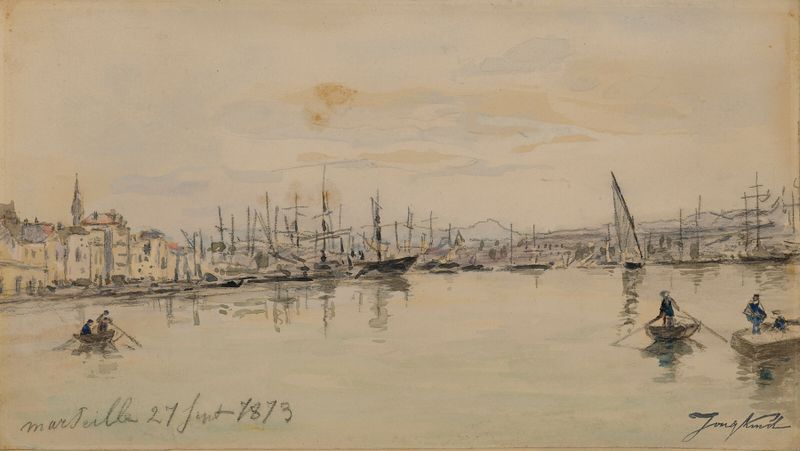
Le Port de Marseille
Johan Barthold Jongkind

Canal Saint-Martin
Johan Barthold Jongkind

Countryside near Brezins, between Grenoble and Vienne
Johan Barthold Jongkind

Notre-Dame vue du quai de la Tournelle
Johan Barthold Jongkind

Environs de Grenoble
Johan Barthold Jongkind

Clair de lune à Overschie (environs de Rotterdam)
Johan Barthold Jongkind

Port de Honfleur
Johan Barthold Jongkind
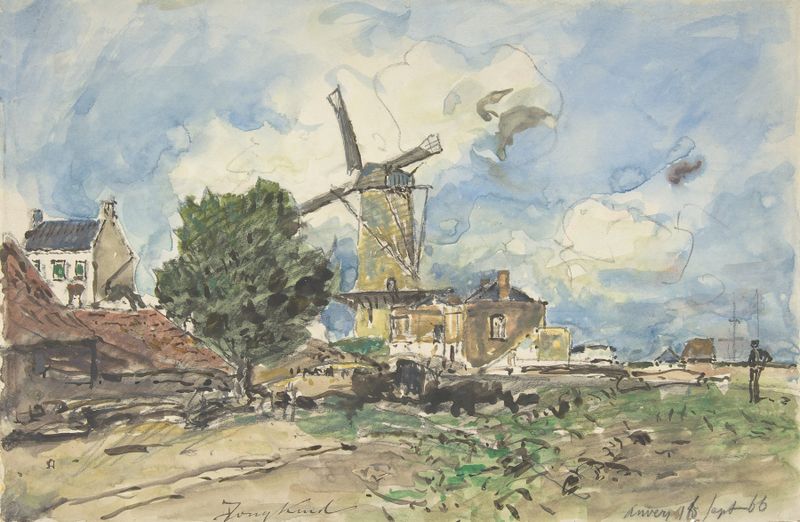
Wind Mill at Antwerp
Johan Barthold Jongkind

Le Havre
Johan Barthold Jongkind

The Church of Overschie
Johan Barthold Jongkind





