
La tour de l’Horloge, la Conciergerie et le pont au Change, en 1621 — History & Facts
In an age where the winds of change sweep through the streets, the rebirth of the old world is painted anew, silent yet resounding. Focus on the vibrant hues that breathe life into La tour de l’Horloge, la Conciergerie et le pont au Change, en 1621. The historical buildings rise majestically against a softly illuminated sky, each structure encapsulating a story waiting to unfold. Notice how the light falls upon the clock tower, casting a gentle glow that enhances its intricate details, while shadows cloak the lower parts of the scene, creating a dance of light and dark that mirrors the passage of time. Amidst the architectural grandeur, you can sense an emotional undercurrent; the juxtaposition of the sturdy stone of the Conciergerie against the ethereal quality of the sky suggests both resilience and fragility.
The bridge, a vital connection, symbolizes the transition between eras, embodying the themes of transformation and continuity. Each brushstroke tells of a rebirth, as if the artist seeks to revive the echoes of a bustling past within the tranquil present. In 1887, Fédor Hoffbauer painted this work while residing in Paris, a city brimming with artistic innovation. The late 19th century was a time of significant social and political change in France, echoing the sentiments of rebirth and renewal reflected in his art.
Hoffbauer, influenced by the historical narratives of the city, sought to capture not just the physical landscape, but the very essence of time and memory entwined within it.
More Artworks by Fédor Hoffbauer
Browse all →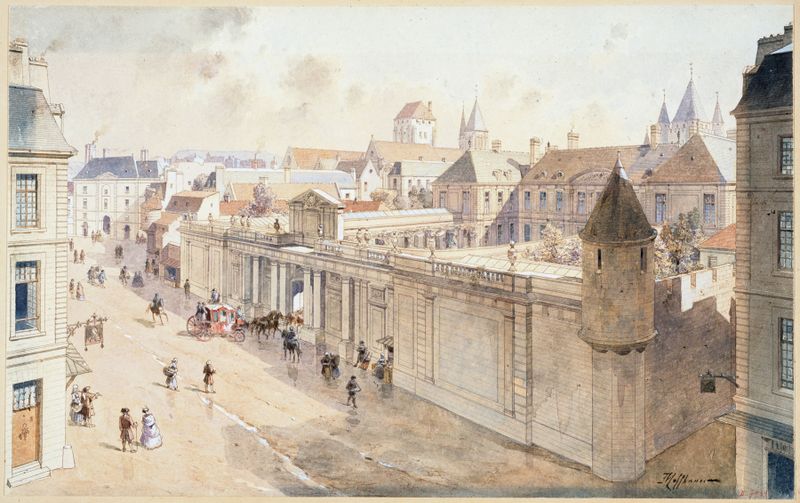
Le palais du Grand Prieur au Temple, en 1770
Fédor Hoffbauer

Banquet des officiers de la marine Russe, dans la salle des fêtes à l’Hôtel de Ville. Fêtes Franco-Russes à Paris
Fédor Hoffbauer

Le Grand Châtelet et le pont de Bois, 1621-1645
Fédor Hoffbauer
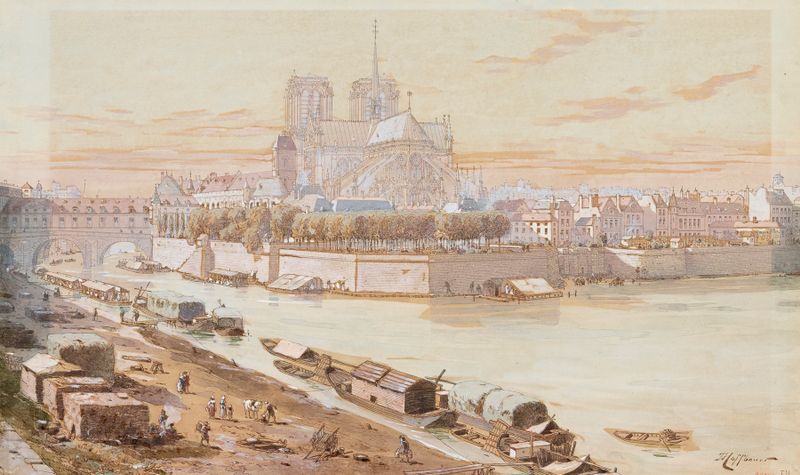
Notre-Dame et l’Evêché en 1750
Fédor Hoffbauer

Vue panoramique de Paris en 1588, depuis les toits du Louvre, avec le Pont-Neuf en construction
Fédor Hoffbauer
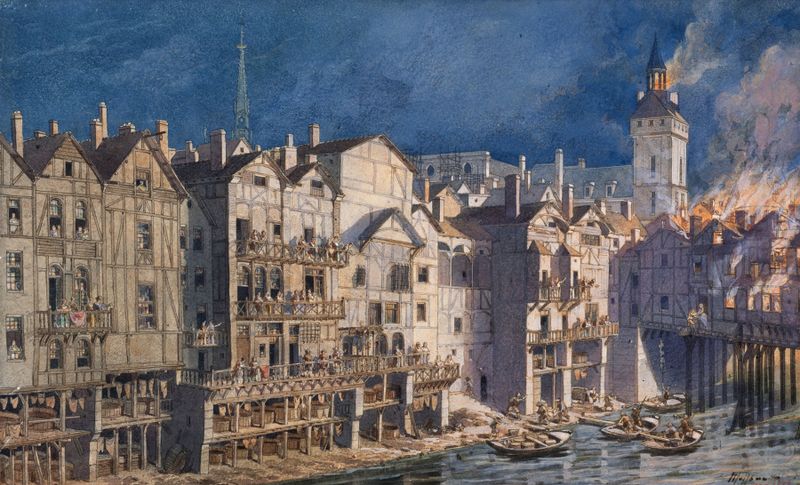
La Cité entre le pont Notre Dame et le pont au Change en 1621
Fédor Hoffbauer

L’Hôtel de Ville et le pont d’Arcole en 1842
Fédor Hoffbauer

Le Cimetière des Innocents en 1750
Fédor Hoffbauer
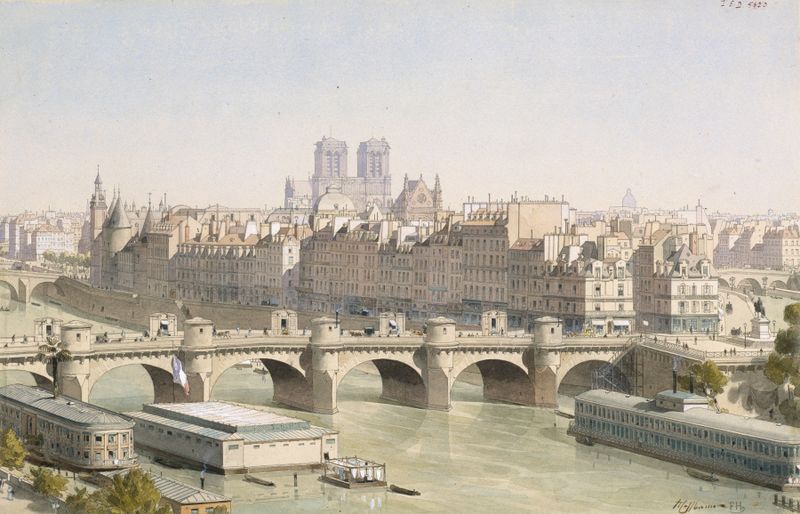
Vue de l’île de la Cité et le pont-Neuf avec ses boutique, vers 1840
Fédor Hoffbauer

Représentation dans la salle des Prévôts à l’Hôtel de Ville, 4ème arrondissement Fêtes Franco-Russes à Paris le 20 oct
Fédor Hoffbauer
More Architecture Art
Browse all →
The statue of Liberty
Frédéric Auguste Bartholdi

View of Houses in Delft, Known as ‘The Little Street’
Johannes Vermeer

View of Houses in Delft, Known as ‘The Little Street’
Johannes Vermeer

The Cathedral in Rouen. The portal, Grey Weather
Claude Monet

The yellow house
Vincent van Gogh

The Church in Auvers-sur-Oise, View from the Chevet
Vincent van Gogh