
Le palais du Grand Prieur au Temple, en 1770 — History & Facts
In the quiet corners of existence, where solitude nestles like a forgotten whisper, one finds the essence of true beauty and longing. Look closely at the intricate details of the architectural facade in Le palais du Grand Prieur au Temple, en 1770. The soft hues of ochre and muted blues command your gaze, drawing your eye to the delicate interplay of light and shadow. Notice how the stillness of the building contrasts with the dynamic brushstrokes that suggest the passage of time, inviting you to ponder the stories held within these walls.
The symmetry of the structure, while visually satisfying, also hints at an underlying emptiness that pervades the scene. As you explore further, consider the subtle emotional tensions in this piece. The grandeur of the palace stands resolute, yet its silence echoes a profound loneliness, as if it mourns the vibrancy that once filled its halls. The surrounding emptiness amplifies this feeling, evoking reflections on isolation and nostalgia.
Each brushstroke serves not just to depict a physical space but to encapsulate the complex relationship between history and human experience. In the tumultuous years between 1915 and 1945, when Hoffbauer created this work, Europe was engulfed in the shadows of war and upheaval. Living in exile, he turned to the past, seeking solace in architectural forms that spoke of a time when beauty and tranquility reigned. This painting reflects not only his artistic journey but also the collective yearning for peace during an era marked by discord and dislocation.
More Artworks by Fédor Hoffbauer
Browse all →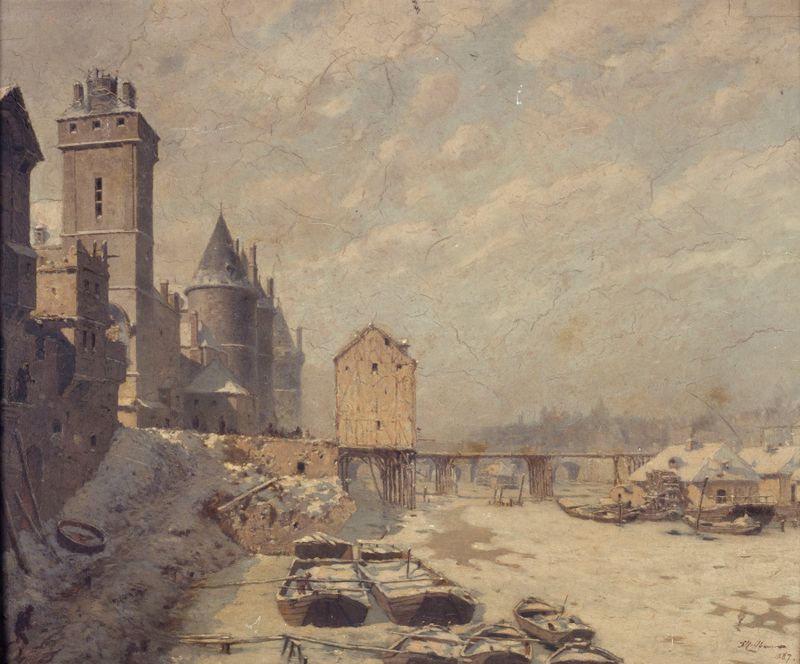
La tour de l’Horloge, la Conciergerie et le pont au Change, en 1621
Fédor Hoffbauer

Banquet des officiers de la marine Russe, dans la salle des fêtes à l’Hôtel de Ville. Fêtes Franco-Russes à Paris
Fédor Hoffbauer

Le Grand Châtelet et le pont de Bois, 1621-1645
Fédor Hoffbauer
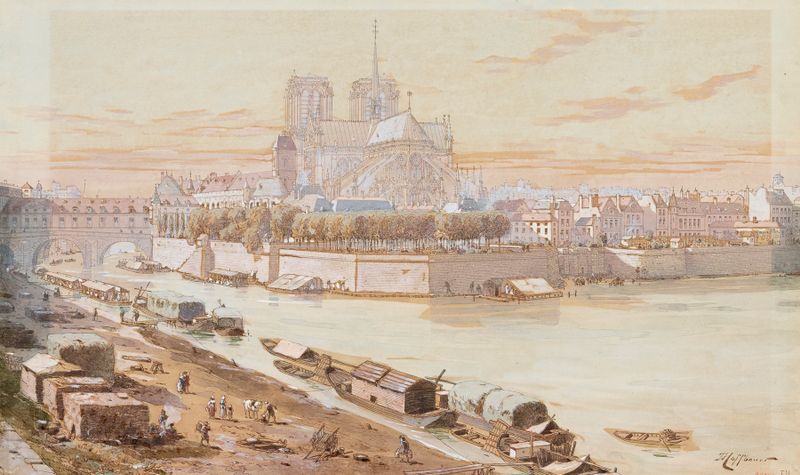
Notre-Dame et l’Evêché en 1750
Fédor Hoffbauer

Vue panoramique de Paris en 1588, depuis les toits du Louvre, avec le Pont-Neuf en construction
Fédor Hoffbauer
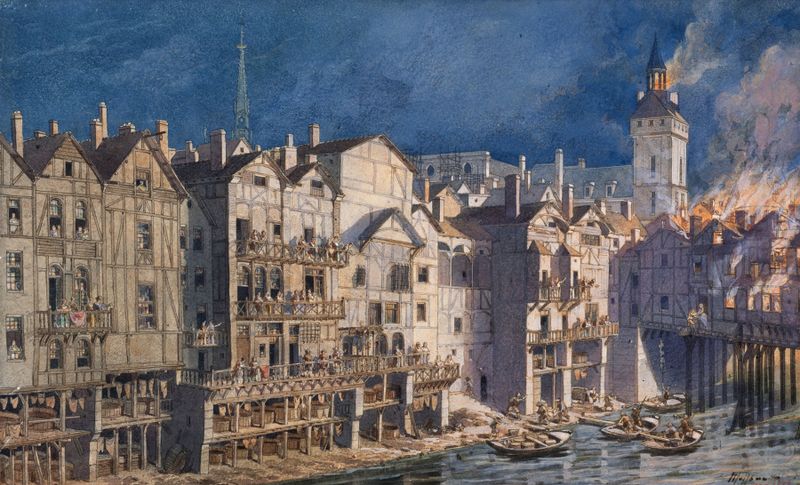
La Cité entre le pont Notre Dame et le pont au Change en 1621
Fédor Hoffbauer

L’Hôtel de Ville et le pont d’Arcole en 1842
Fédor Hoffbauer

Le Cimetière des Innocents en 1750
Fédor Hoffbauer
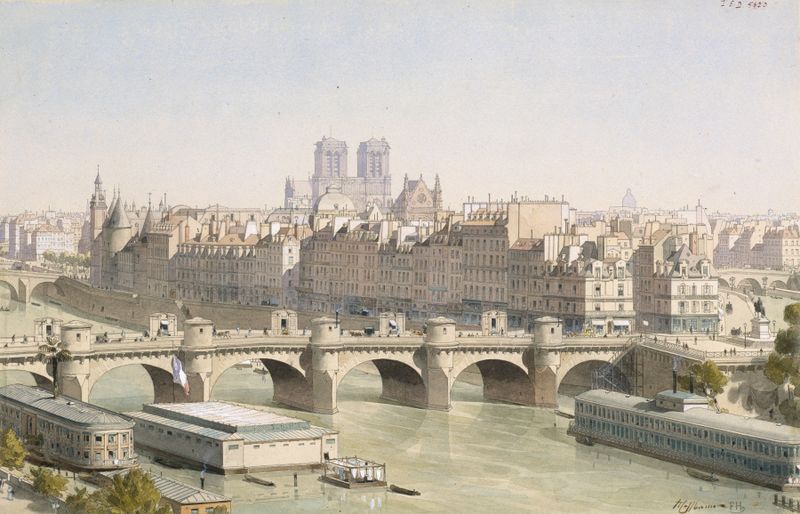
Vue de l’île de la Cité et le pont-Neuf avec ses boutique, vers 1840
Fédor Hoffbauer

Représentation dans la salle des Prévôts à l’Hôtel de Ville, 4ème arrondissement Fêtes Franco-Russes à Paris le 20 oct
Fédor Hoffbauer
More Architecture Art
Browse all →
The statue of Liberty
Frédéric Auguste Bartholdi

View of Houses in Delft, Known as ‘The Little Street’
Johannes Vermeer

View of Houses in Delft, Known as ‘The Little Street’
Johannes Vermeer

The Cathedral in Rouen. The portal, Grey Weather
Claude Monet

The yellow house
Vincent van Gogh

The Church in Auvers-sur-Oise, View from the Chevet
Vincent van Gogh