
Landscape in Chikugo — History & Facts
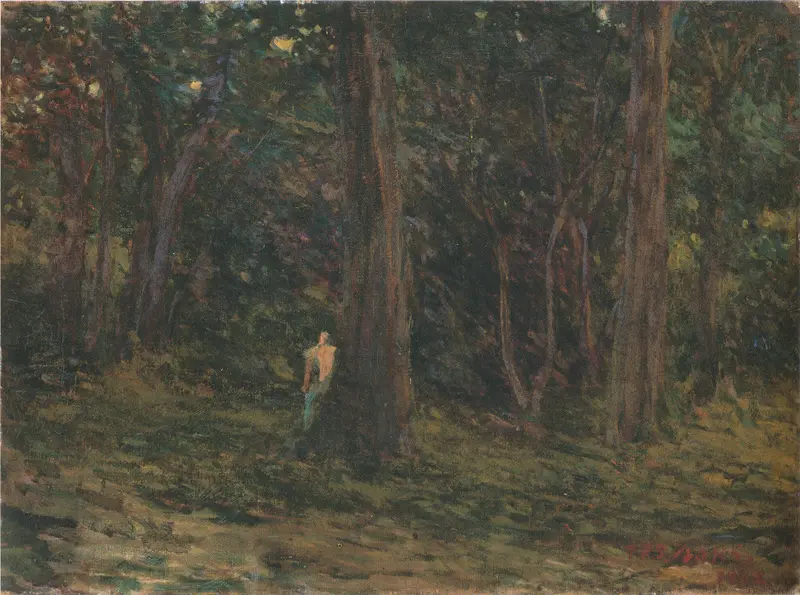
What first catches the eye in Landscape in Chikugo is the way the trees seem to lean and twist, reaching upward as if shaped by the wind and time itself. The viewer’s gaze is drawn along the rough, reddish trunks, then pulled down to the solitary rider who slips quietly into the shadowed woods. The palette is gentle but restless: greens and browns mingle with a faint, purplish haze, giving the scene a sense of movement and watchfulness.
The rider, dwarfed by the towering trees, becomes a fleeting presence—more suggestion than protagonist—while the trees themselves command the stage, their forms both protective and imposing. Created in 1908, this work by Aoki Shigeru belongs to a moment when Japanese artists were absorbing and transforming Western painting techniques, especially in landscape. The era saw a surge of interest in capturing the local countryside, not as a backdrop but as a living character, often painted for private patrons or exhibitions seeking to define a modern Japanese identity. Little is recorded about the particular journey of this painting, now known from its inclusion in a 1963 volume on Aoki Shigeru’s work.
Yet its quiet drama and subtle play of light invite us to linger, searching for the story in the spaces between the branches.
More Artworks by Aoki Shigeru
More Landscape Art

The Starry Night
Vincent van Gogh

View of Delft
Johannes Vermeer

Water Lilies
Claude Monet

The Grand Canal, Venice, looking north-west from the Ca' Corner to the Ca' Contarini degli Scrigni, with the campanile of Santa Maria della Carità
Canaletto

Windsor Castle
Canaletto

The Grand Canal looking North-East from the Palazzo Dolfin-Manin to the Rialto Bridge
Canaletto