
Landscape with Cattle (SK-C-162) — History & Facts
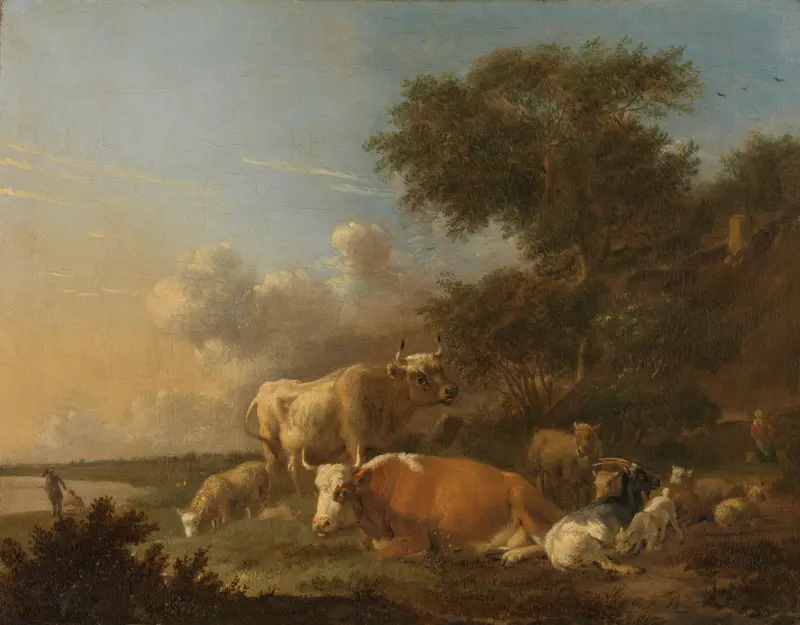
The hush of a late afternoon settles across the scene, and the eye is drawn first to the gentle congregation of cattle, sheep, and goats, their bodies at rest beneath a canopy of trees. The painter, Albert Jansz Klomp, arranges his animals not as mere stock but as characters in a quiet rural drama, each one caught in a moment of calm. The light, golden and low, lingers on the backs of the reclining cows, picking out the soft curve of a horn, the rough texture of a hide, and the patient gaze of creatures at ease.
Nearby, a woman crosses the field with a yoke and buckets balanced on her shoulders, her red bodice a deliberate note of color against the muted earth and sky. The farmhouse, half-shadowed under the trees, anchors the left edge, while the open sky claims the right, filled with clouds that seem to drift as slowly as the day itself. This is the world of the Dutch Golden Age, when artists like Klomp found poetry in the everyday rhythms of rural life. Painted between 1640 and 1688, works such as this served a growing appetite among urban collectors for scenes of the countryside—images that promised peace, order, and abundance.
The careful attention to animal breeds and rustic labor reflects a culture newly attentive to the land’s productivity and the dignity of its keepers. While little is recorded about the journey of this particular painting before it entered the Rijksmuseum collection, it stands as a pendant to another work, inviting viewers to imagine the pair as windows onto a vanished landscape. Step closer and let your eye wander: every detail here is a quiet invitation to linger.
More Artworks by Albert Jansz Klomp

More Landscape Art

The Starry Night
Vincent van Gogh

View of Delft
Johannes Vermeer

Water Lilies
Claude Monet

The Grand Canal, Venice, looking north-west from the Ca' Corner to the Ca' Contarini degli Scrigni, with the campanile of Santa Maria della Carità
Canaletto

Windsor Castle
Canaletto

The Grand Canal looking North-East from the Palazzo Dolfin-Manin to the Rialto Bridge
Canaletto