Landschaft mit Häusern und Bäumen — History & Facts
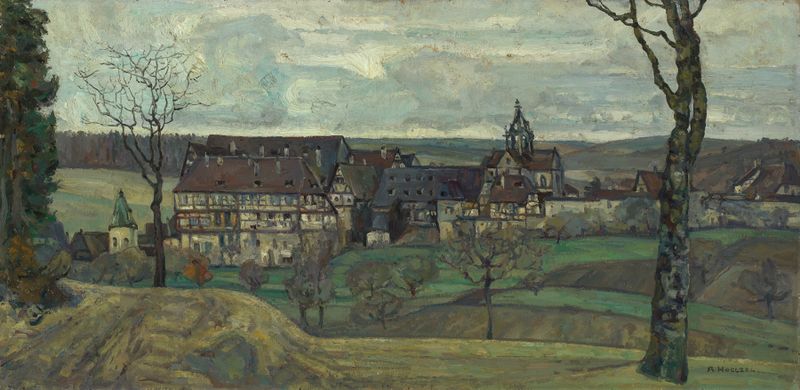
In the stillness of a landscape, one can sense the echoes of life and silence entwined, holding the viewer in a contemplative embrace. Look to the left at the gentle slope of the hills, where muted greens softly blend with the earthy browns of the cottages scattered below. The trees rise like guardians, their trunks robust and textured, while the dappled light filtering through the foliage creates a play of contrast, emphasizing the tranquility of the scene. Notice how Hölzel employs soft brushstrokes, allowing color to breathe and creating a sense of unity between the homes and their natural surroundings. The emotional tension lies in the juxtaposition of human presence against the vastness of nature.
Each house is distinct yet connected, suggesting a harmony that may conceal a deeper longing for solitude. The lack of movement or activity draws attention to the profound stillness, inviting reflection on the simple yet profound nature of existence. The colors, though muted, resonate with an unspoken narrative, evoking a sense of nostalgia and yearning. In 1905, the artist was immersed in the artistic movements of his time, experimenting with color theory and abstraction while living in Munich.
This period marked a significant evolution in his style as he sought to capture the essence of his subjects rather than mere representation. Amidst the tumultuous changes in the art world, Landschaft mit Häusern und Bäumen stands as a testimony to Hölzel’s ability to convey emotional depth through serene landscapes.