Landschaft mit ruhenden Hirten — History & Facts
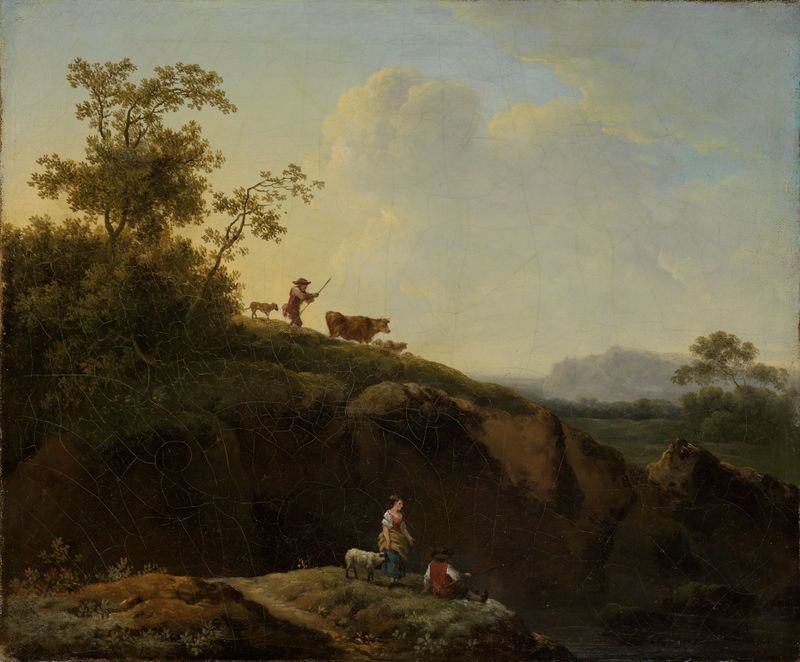
It is in this serene landscape that tranquility whispers through the rustling grass and the soft hues of the sky, inviting the viewer to pause and reflect. Look to the left, where gentle folds of green and brown converge into a tranquil expanse. The shepherds stand as guardians of this peaceful realm, their quiet forms contrasted against the expansive backdrop of rolling hills and a hint of distant mountains. Notice how the subdued palette of earth tones, punctuated by dappled light, creates a sense of harmony, pulling your gaze toward the leisurely rhythm of pastoral life. In the delicate brushwork, one can uncover a deeper commentary on existence itself.
The resting shepherds, perhaps suggestive of humanity's relationship with nature, evoke a sense of contemplation and the passage of time. The slight variations in light across the landscape symbolize both the fleeting nature of moments and the enduring beauty found in stillness, urging the viewer to find solace in simplicity. Georg Friedrich Meyer painted this work in 1764 during a time of shifting artistic paradigms in Germany. He was immersed in the burgeoning movement of German Romanticism, emphasizing emotion and nature's beauty.
By capturing the essence of serenity through landscapes, Meyer not only contributed to this emerging genre but also reflected the broader philosophical ideas that were shaping the consciousness of his contemporaries, seeking meaning in a rapidly changing world.