Landschap bij de duinen met een mijlpaal en twee wandelaars — History & Facts
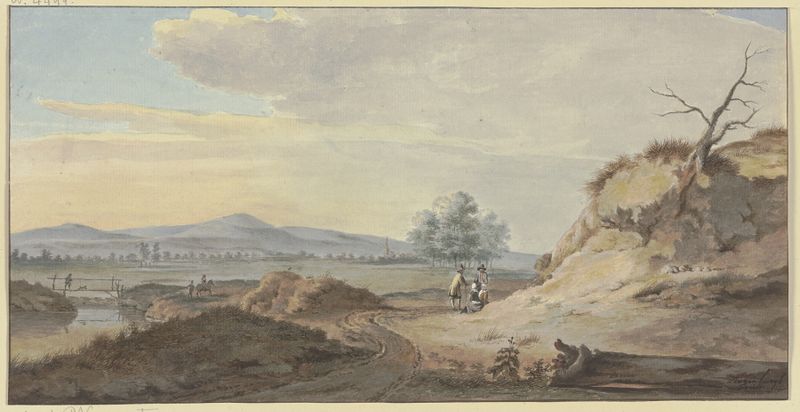
In the quiet embrace of nature, movement whispers, reminding us of the delicate balance between stillness and the passage of time. Focus on the lower right corner, where two figures traverse the undulating sand dunes. Their subtle gestures are brought to life by Toorenburgh's soft brushwork and muted palette, which evokes a sense of serenity interlaced with the promise of an unseen journey. Notice how the light dances across the dunes, casting gentle shadows that contour the landscape and lend depth to the scene.
The milestone stands silently in the foreground, an eternal witness to the rhythms of life and nature, guiding the eye toward the horizon. The contrast between the solidity of the milestone and the ethereal movements of the wanderers speaks to the transient nature of existence. The figures, though anchored in place, seem to embody the essence of journeying—both physically across the dunes and metaphorically through the passage of life. The vast sky, painted in soft hues, draws our gaze upward, evoking a sense of infinity and possibility.
Through this composition, the artist captures a moment that transcends time, urging us to reflect on our own paths. In 1765, Gerrit Toorenburgh painted this landscape amidst a flourishing Dutch art scene that celebrated the harmony of nature and humanity. Living in an era when landscape painting was gaining prominence, Toorenburgh found his voice in this genre, showcasing the interplay between light, form, and the human experience. His dedication to capturing tranquil moments in nature reflects the broader Romantic movement that sought to connect deeply with the world around us.