Le Marché et la fontaine des Innocents — History & Facts
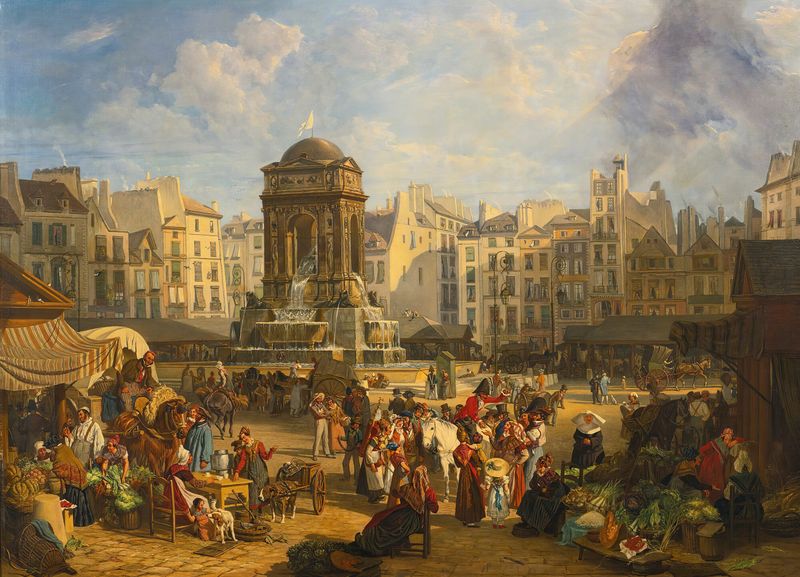
In the quiet folds of life, the essence of grief often lingers, waiting to be transformed into something beautiful. This work invites the viewer to encounter the delicate interplay of daily existence and underlying sorrow. Look to the foreground at the bustling market scene, where figures bustle about their mundane tasks. Notice how the warm, earthy palette of ochres and browns juxtaposes with the cooler tones of the fountain, drawing your eye toward the heart of the composition.
The interplay of light dances on the water's surface, creating a flickering reflection that hints at deeper emotions hidden beneath the surface of daily life. Chalon's brushstrokes convey movement and life, yet there is an underlying stillness that suggests a moment paused in contemplation. As you delve deeper, consider the expressions of the figures — some animated in joy or chatter, while others appear lost in thought. This contrast highlights the fluctuating nature of human experience, where happiness and grief often coexist in close proximity.
The market, usually a symbol of vibrance and community, subtly transforms into a sanctuary for unspoken sorrows, as if each passerby carries a fragment of their own heartache within them. In 1822, during a time when Chalon was establishing his reputation in London, his focus shifted toward capturing the essence of everyday life infused with emotional resonance. The art world was evolving, moving toward realism and away from idealized forms. Chalon was inspired by this shift and sought to portray not just the scene, but the unvoiced narratives that weave through the fabric of existence, revealing the profound connections between loss and the liveliness of the moment.