
View Of The Market And Fontaine Des Innocents, Paris — History & Facts
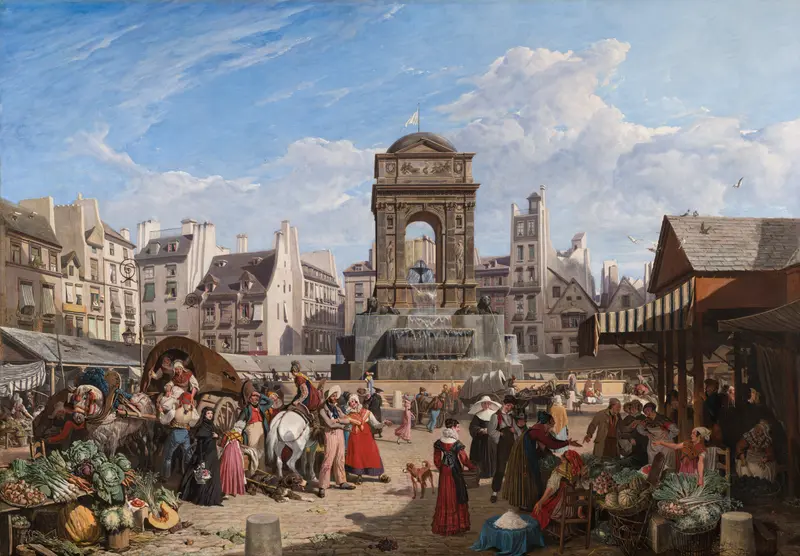
Could beauty survive in a century of chaos? In View Of The Market And Fontaine Des Innocents, Paris, the essence of life unfurls amidst the bustle of a vibrant Parisian market, where the dance of existence intertwines with the stark realities of mortality. Look to the center of the canvas, where the Fontaine des Innocents rises majestically, its sculpted figures catching the eye. Notice how the soft, golden light washes over the scene, illuminating the bustling stalls and the varied characters of market-goers. Rich, warm hues of ochre and earthy browns ground the composition, contrasting with the delicate blues and whites of the sky, inviting the viewer's gaze to wander through the lively interactions and gestures of the people, all alive with purpose. Yet, beneath this lively facade, a deeper narrative of transience unfolds.
The fountain, a symbol of rejuvenation, stands in stark contrast to the ephemeral nature of the market—a place where goods are exchanged, lives intersect, and moments slip away. The playful interplay of shadow and light hints at the passage of time and mortality, while the figures, lost in their daily pursuits, evoke a poignant reminder of the fragility of existence amidst their vibrant surroundings. In 1826, John James Chalon painted this scene during a period marked by significant change in Paris, reflecting the societal shifts wrought by the aftermath of the French Revolution. As a prominent artist of his time, he navigated the evolving artistic landscape, capturing the essence of everyday life while infusing it with a sense of humanity and depth that resonates even today.
More Artworks by John James Chalon
More Genre Scene Art

Banquet of the Officers of the St George Civic Guard
Frans Hals

Rembrandt and Saskia in the Scene of the Prodigal Son
Rembrandt van Rijn

Bal du moulin de la Galette
Pierre-Auguste Renoir

Quadrille at the Moulin Rouge
Henri de Toulouse-Lautrec

A Burial at Ornans
Gustave Courbet

When Will You Marry?
Paul Gauguin