
London Bridge — History & Facts
Could a single brushstroke hold eternity? In London Bridge, the tension of time and movement collides with the stillness of the painted scene, encapsulating a moment that echoes with the weight of history and the violence of change. Look to the foreground where the bridge stretches across the canvas, its arches gracefully curving against the backdrop of a bustling city. Notice how the palette of muted grays and blues speaks to a sense of melancholy, while splashes of vibrant color hint at life and movement. The brushwork is loose and expressive, creating a dynamic interplay between light and shadow that pulls the viewer’s eye toward the heart of the composition, where figures traverse the bridge, each one a fleeting whisper of humanity amidst the architectural permanence. Dig deeper, and one can sense a contrast between the stability of the bridge and the chaos of the urban life surrounding it.
Each figure appears almost ghost-like, suggesting the impermanence of human existence against the backdrop of a monumental structure. The clouds overhead, swirling and heavy, evoke a feeling of impending change—perhaps a reflection on the rapid industrialization and urbanization that was reshaping London in the late 19th century, hinting at the violence of progress as much as the beauty it brings. At the time of creating London Bridge, Childe Hassam was living in New York, influenced by both Impressionism and the burgeoning American art scene. Painted in 1898, this work reflects a moment of transition in his career, as he began to explore subjects beyond the serene landscapes that first defined his oeuvre.
The world was witnessing vast changes, and Hassam's response, through this piece, captures not only the physical structure but the emotional weight of a city in flux.
More Artworks by Childe Hassam
Browse all →
Beach at Newport
Childe Hassam

Washington Arch, Spring
Childe Hassam

Thaxter’s Garden
Childe Hassam

New England Headlands
Childe Hassam

Rocks At Appledore, Morning
Childe Hassam
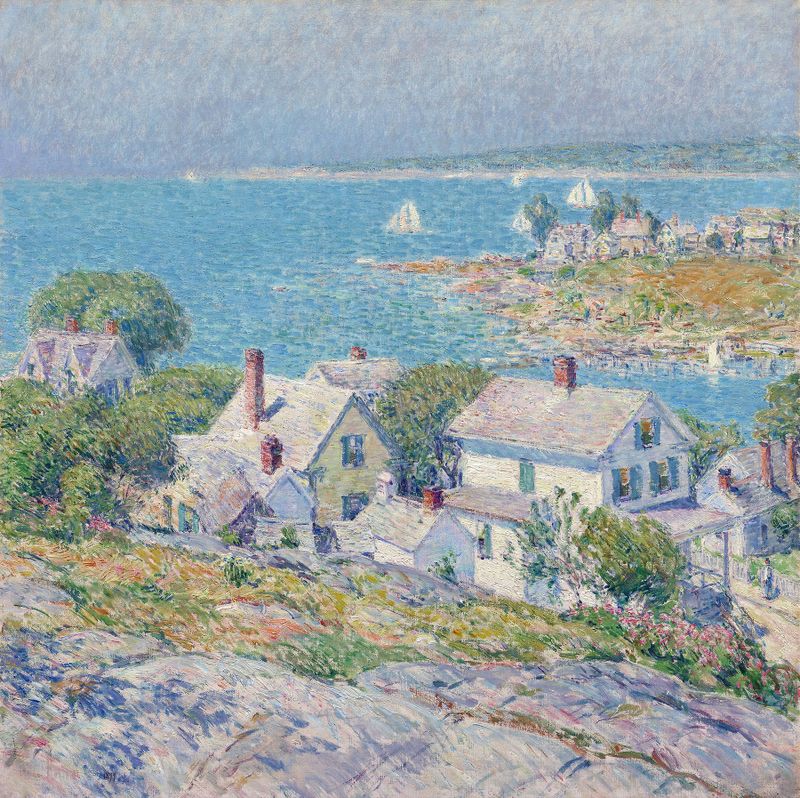
New England Headlands
Childe Hassam
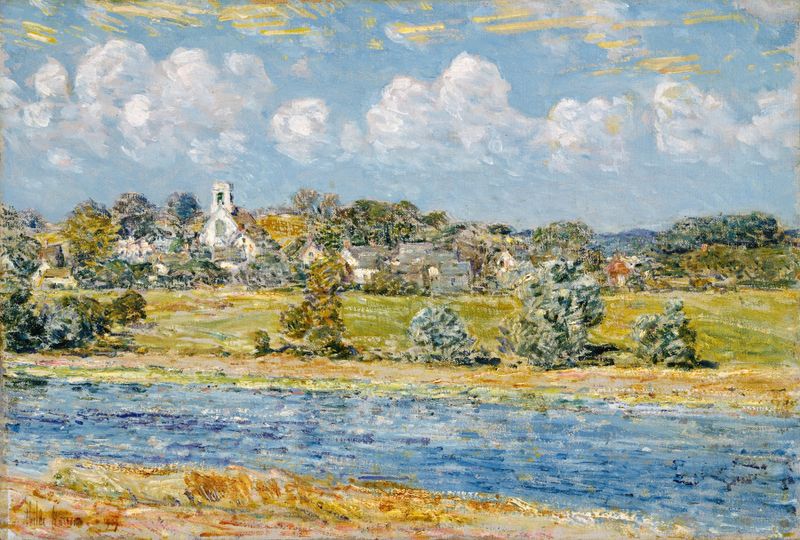
Landscape at Newfields, New Hampshire
Childe Hassam

Piazza di Spagna, Rome
Childe Hassam

The Harbor
Childe Hassam

Late Afternoon, New York, Winter
Childe Hassam
More Architecture Art
Browse all →
The statue of Liberty
Frédéric Auguste Bartholdi

View of Houses in Delft, Known as ‘The Little Street’
Johannes Vermeer

View of Houses in Delft, Known as ‘The Little Street’
Johannes Vermeer

The Cathedral in Rouen. The portal, Grey Weather
Claude Monet

The yellow house
Vincent van Gogh

The Church in Auvers-sur-Oise, View from the Chevet
Vincent van Gogh