London from Islington Hill — History & Facts
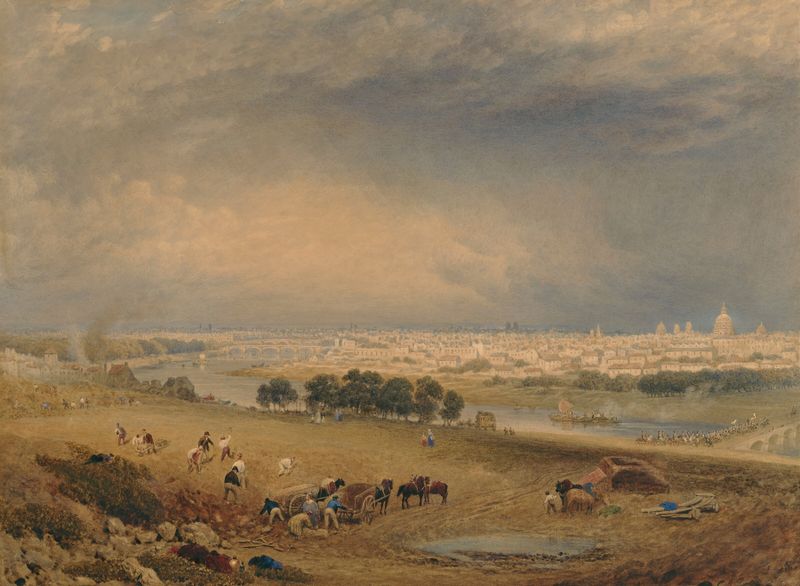
In the quiet interplay of hues, the essence of mortality emerges, whispering through the palette of life and decay. In London from Islington Hill, the viewer's gaze is drawn to the sprawling cityscape, where the rooftops and spires vie for attention under a luminous sky. Look closely at the delicate brushstrokes that render the fog-tinged horizon, where the soft blues and muted earth tones blend seamlessly. Notice how the light is captured not just as illumination but as a gentle caress, enveloping the landscape in a serene embrace, fostering a sense of tranquility amidst the bustling life below. Yet, amid the picturesque charm of the scene lies an underlying tension.
The serene beauty of the city evokes a fleeting sense of nostalgia, suggesting the impermanence of life itself. The winding roads and distant silhouettes hint at the unseen lives unfolding, emphasizing the contrast between the vibrant moment captured and the inevitable passage of time. Each element, from the wisps of clouds to the distant chimneys, serves as a reminder that even in a moment of stillness, change is eternal and inescapable. Frederick Nash painted this piece in the early 19th century, during a time when London was undergoing rapid industrial expansion.
This period was marked by a shift in artistic sensibilities, with many artists exploring urban themes and the relationship between nature and burgeoning civilization. As Nash stood atop Islington Hill, he captured not only the beauty of the city but also an awareness of the transitory nature of existence, reflecting the sentiments that were beginning to emerge in the art world around him.