
Somerset House, London — History & Facts
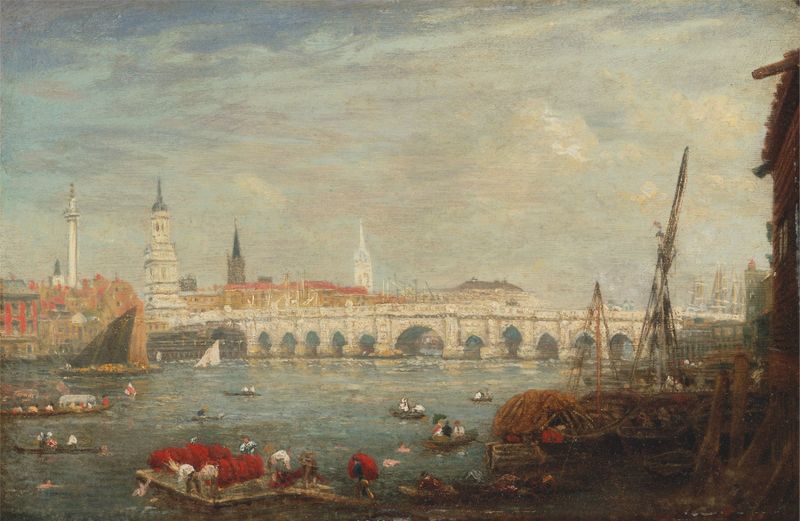
In the quiet corridors of our existence, mortality whispers through the brushstrokes of memory and place. Look to the left at the gentle ripples of the Thames, where the water reflects both the somber sky and the timeless facade of Somerset House. The muted color palette evokes a sense of stillness, interrupted only by the soft contrast of warm browns and cool grays that encapsulate the structure. Notice how the light catches the intricate details of the building’s architecture, revealing the grandeur of its neoclassical columns while simultaneously casting long shadows that hint at the passage of time. In the interplay of light and structure, one can sense the quiet tension between permanence and transience.
The juxtaposition of the enduring architecture against the ephemeral nature of the surrounding water invites contemplation of life’s fleeting moments. The almost ghostly presence of the figures in the foreground serves as a reminder of our mortality, their silhouettes blending into the backdrop, as if they, too, are part of the landscape—alive yet fading. Frederick Nash painted this evocative scene during a time when the British art world was embracing a blend of Romanticism and Realism, with an emerging focus on capturing the essence of place. Though the exact date is unknown, it likely reflects the artist's experiences in early 19th-century London, a period marked by rapid change and a burgeoning interest in landscape art, as artists sought to represent the emotional resonance of their environments.
More Artworks by Frederick Nash
Browse all →



More Architecture Art
Browse all →
The statue of Liberty
Frédéric Auguste Bartholdi

View of Houses in Delft, Known as ‘The Little Street’
Johannes Vermeer

View of Houses in Delft, Known as ‘The Little Street’
Johannes Vermeer

The Cathedral in Rouen. The portal, Grey Weather
Claude Monet

The yellow house
Vincent van Gogh

The Church in Auvers-sur-Oise, View from the Chevet
Vincent van Gogh