
Molens bij Rotterdam — History & Facts
In Molens bij Rotterdam, the illusion of a tranquil moment serves as a window into the Dutch landscape, capturing the subtle interplay between nature and human ingenuity. Look to the left at the towering windmills, their sails poised against a backdrop of softly swirling clouds. The light dances across the scene, illuminating the delicate strokes of white and blue that suggest the shimmering water below. Notice how the artist employs a palette of muted greens and blues, evoking a sense of calm while contrasting with the warm earth tones of the windmills.
This masterful technique not only highlights the structures but also embodies the harmonious relationship between land and sky. Yet beneath the serene surface lies a tension between progress and tradition. The windmills, symbols of an industry that shaped Dutch identity, stand resilient amidst an evolving landscape. The gentle waves reflect the modernity hinted at by the distant ships, signifying change on the horizon.
Each brushstroke captures not only a scene but also the emotional weight of nostalgia and anticipation, whispering of a world on the brink of transformation. During the summer of 1867, Jongkind painted this piece while residing in France, amidst the broader art movement that embraced impressionism and realism. He was grappling with his own identity as an artist, caught between the classical teachings of the past and the emerging avant-garde techniques. This work exemplifies his innovative spirit, as he sought to convey not just the physical landscape, but also the transient beauty of life itself.
More Artworks by Johan Barthold Jongkind
Browse all →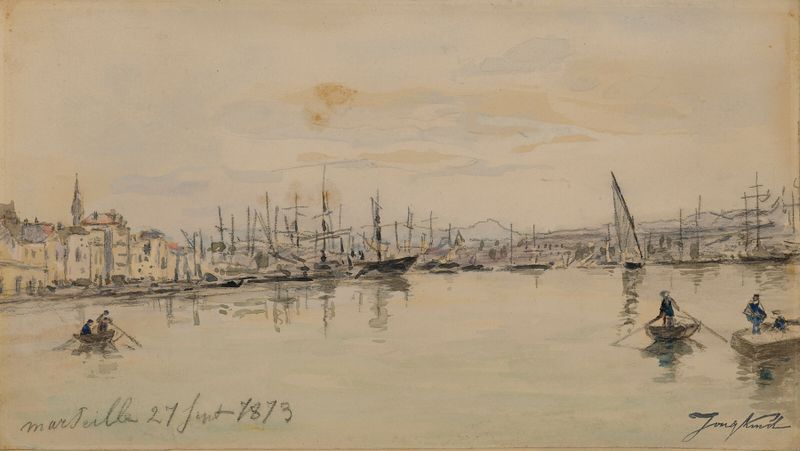
Le Port de Marseille
Johan Barthold Jongkind

Canal Saint-Martin
Johan Barthold Jongkind

Countryside near Brezins, between Grenoble and Vienne
Johan Barthold Jongkind

Notre-Dame vue du quai de la Tournelle
Johan Barthold Jongkind

Environs de Grenoble
Johan Barthold Jongkind

Clair de lune à Overschie (environs de Rotterdam)
Johan Barthold Jongkind

Port de Honfleur
Johan Barthold Jongkind
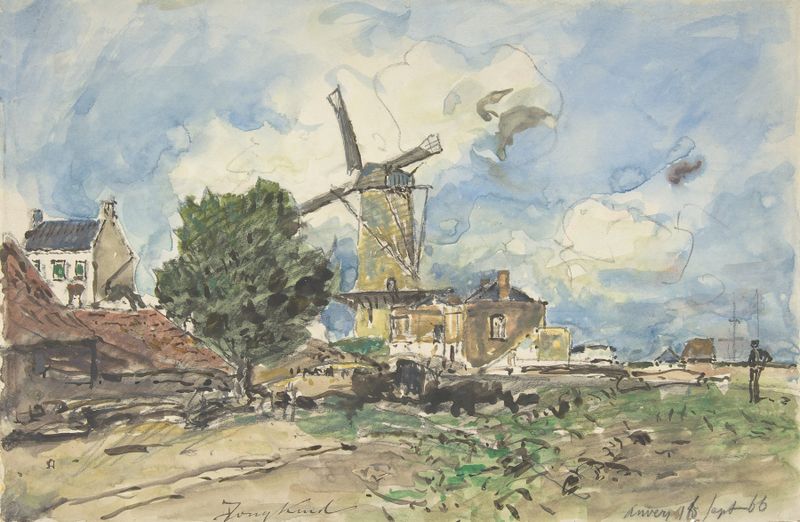
Wind Mill at Antwerp
Johan Barthold Jongkind

Le Havre
Johan Barthold Jongkind

The Church of Overschie
Johan Barthold Jongkind





