
Moulin et scierie, Hollande — History & Facts
Can paint confess what words never could? In Moulin et scierie, Hollande, the canvas speaks of emptiness, a silence that reverberates through the stillness of the scene. Look to the left at the gently turning blades of the windmill, their stark outlines against the muted sky. The artist employs a palette of soft blues and greys, creating a haunting atmosphere that makes the viewer acutely aware of the absence of human presence. Notice how the light filters through the clouds, subtly illuminating the scene, yet leaving much in shadow, as if hinting at a lost vibrancy.
The composition invites the eye to wander—a meandering river flows through the foreground, while distant fields stretch towards the horizon, suggesting both continuity and isolation. The emotional tension lies in the contrast between nature’s majesty and the stark simplicity of man’s structures. The windmill, a symbol of industriousness, stands alone, reinforcing a profound sense of solitude. The delicate brushwork captures the underlying vibrancy of a once-bustling locale now left stagnant.
Each element, from the gentle ripples in the water to the distant trees, speaks of a past life, evoking a bittersweet nostalgia that is both painful and beautiful. In 1843, at a time when the Dutch landscape was undergoing significant changes due to industrialization, Jongkind found himself in France, grappling with his identity as an artist. This period marked a transition in his style, where he began to embrace the impressionistic techniques that would later define his legacy. It was a time of exploration for him, both personally and artistically, as he sought to capture the essence of landscapes that resonated deeply within him.
More Artworks by Johan Barthold Jongkind
Browse all →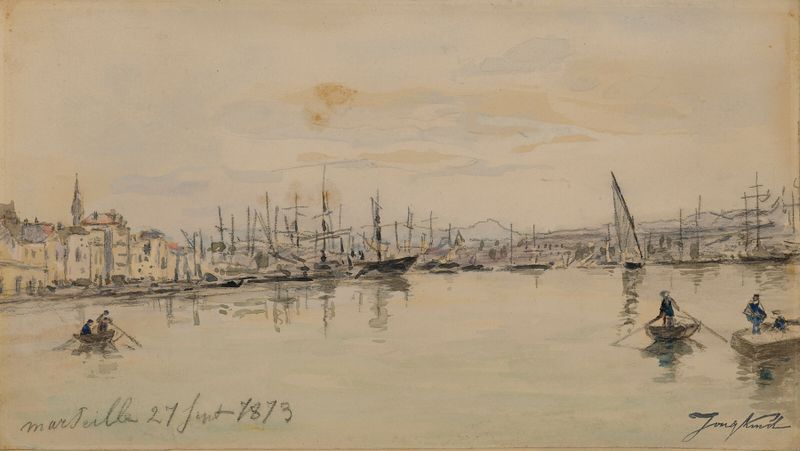
Le Port de Marseille
Johan Barthold Jongkind

Canal Saint-Martin
Johan Barthold Jongkind

Countryside near Brezins, between Grenoble and Vienne
Johan Barthold Jongkind

Notre-Dame vue du quai de la Tournelle
Johan Barthold Jongkind

Environs de Grenoble
Johan Barthold Jongkind

Clair de lune à Overschie (environs de Rotterdam)
Johan Barthold Jongkind

Port de Honfleur
Johan Barthold Jongkind
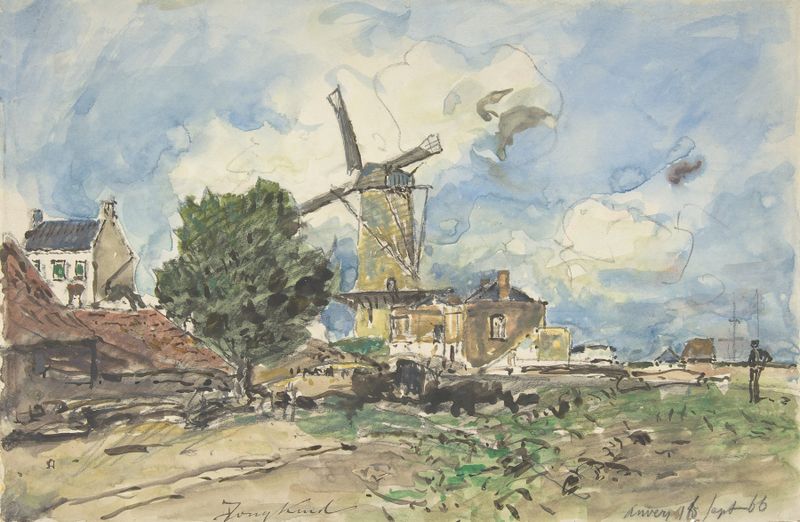
Wind Mill at Antwerp
Johan Barthold Jongkind

Le Havre
Johan Barthold Jongkind

The Church of Overschie
Johan Barthold Jongkind





