
My little cabbage! — History & Facts
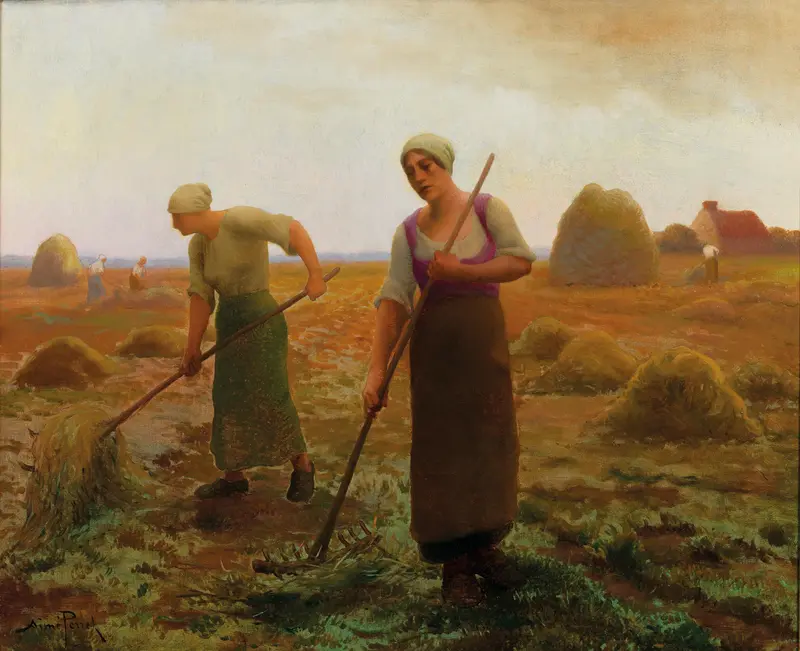
Sunlight pools across the cabbage patch, drawing the eye first to the small child in blue, clutching a head of cabbage almost as large as their own. The mother stands nearby, her posture relaxed but attentive, a gentle smile playing at the corners of her mouth. The lush green of the cabbages leads us through the scene, guiding us from the foreground intimacy of mother and child to the distant figure laboring with a hoe, and finally toward the horizon where a farmhouse nestles under a sweep of cloud-streaked sky.
Every detail—the sturdy shoes, the rolled sleeves, the careful composition of light and shadow—signals a world where work and affection intertwine. The palette, fresh and bright, sets a mood of quiet pride and everyday contentment. Painted in 1893, My little cabbage! by Aimé Perret belongs to a moment when European artists turned their attention to rural life, celebrating the dignity of labor and the bonds of family. Such scenes were cherished by a growing middle class who sought reminders of honest work and simple joys, even as industrialization transformed the landscape.
Works like this, auctioned at Christie’s in South Kensington as part of a 19th-century European art collection, remind us how quickly history can swallow the details of ordinary lives—yet here, in the cabbage patch, the warmth of a summer day and the affection between mother and child endure. Notice how the painting invites you to linger, to imagine the voices and laughter just out of earshot.
More Artworks by Aimé Perret


More Genre Scene Art

Banquet of the Officers of the St George Civic Guard
Frans Hals

Rembrandt and Saskia in the Scene of the Prodigal Son
Rembrandt van Rijn

Bal du moulin de la Galette
Pierre-Auguste Renoir

Quadrille at the Moulin Rouge
Henri de Toulouse-Lautrec

A Burial at Ornans
Gustave Courbet

When Will You Marry?
Paul Gauguin