Parterre im Schönbrunner Schlosspark — History & Facts
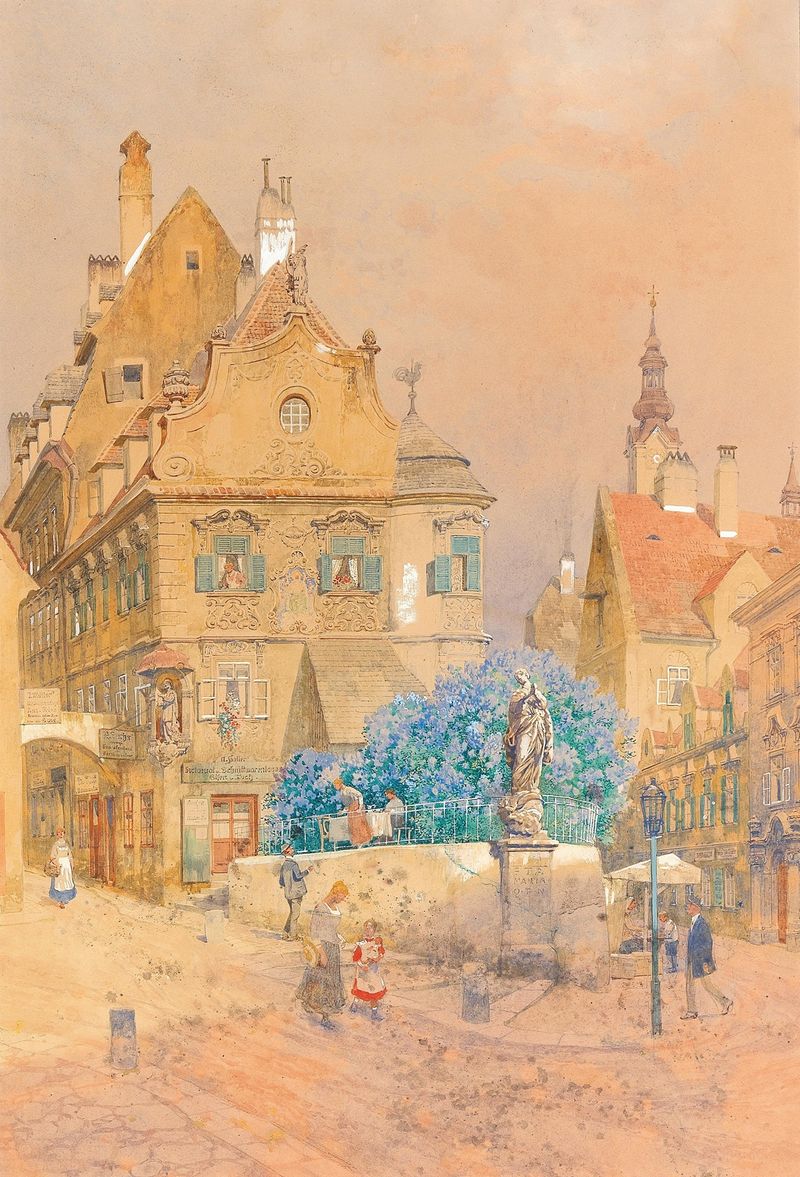
Can beauty exist without sorrow? Parterre im Schönbrunner Schlosspark captures a fleeting moment where nature's allure dances in the realm of illusion, inviting contemplation on the bittersweet essence of existence. Focus first on the meticulously arranged flowerbeds, their vibrant colors forming intricate patterns that guide your gaze across the canvas. The precision in Kopallik's brushwork highlights not just the blooms but also the interplay of light and shadow, which creates a sense of depth. Notice how the soft sunlight filters through the trees, casting dappled reflections on the paths, bringing the entire scene to life with a gentle warmth that belies the underlying complexity. Beneath the surface beauty lies a tension between order and chaos.
The carefully cultivated parterre represents human influence, while the surrounding park hints at nature's untamed spirit. This contrast reflects the duality of existence—where joy mingles with melancholy, and every moment of perfection holds the weight of impermanence. Each flower, while vibrant in its bloom, carries the knowledge of its eventual decay, a poignant reminder of the cycle of life. Franz Kopallik created this work during an era marked by a fascination with nature in art.
Little is known about the exact date, but his focus on landscapes aligns with the Romantic ideals of the late 19th century. As artists were increasingly drawn to portray nature’s beauty, Kopallik’s detailed representation in Parterre im Schönbrunner Schlosspark embodies the tension of illusion and reality, reflecting both personal and collective experiences in an ever-changing world.