
Patineurs À Maassluis — History & Facts
In a realm where reality melds with dreams, whispers of palette and brush convey the quietude of a wintry landscape, where figures glide across a frozen canvas of ice and snow. Here, we find ourselves at the intersection of nature and emotion, where the essence of humanity skates gracefully upon ephemeral moments. Look to the foreground, where skaters weave a delicate dance, their movements captured mid-glide. Notice how the frosty air sparkles around them, with soft hues of blue and pale yellow illuminating the scene.
The artist employs loose brushwork that conveys both motion and tranquility, while the gentle curve of the horizon invites the eye to wander deeper into the frosted expanse. Shadows play at the feet of the skaters, grounding their fleeting joy in the reality of winter’s chill. As you delve deeper, consider how the contrasting colors evoke a bittersweet harmony—the vibrancy of the figures against the muted backdrop suggests a fleeting joy amidst the silence of winter. Each skater embodies a moment of connection, their individual expressions hinting at stories untold.
The ice, both a surface for recreation and a metaphor for the fragility of life, serves as a reminder of the transient nature of happiness, hinting at the delicate balance between joy and solitude. Created in 1862, this work emerged during a transformative time in the art world, as Jongkind sought to break free from traditional confines in favor of impressionistic expression. Working in the Netherlands, he was heavily influenced by the evolving techniques of his contemporaries, navigating the exciting tension between realism and impressionism. This period marked a shift toward capturing fleeting moments, and in his hands, Patineurs À Maassluis becomes a reflection of both personal introspection and broader artistic evolution.
More Artworks by Johan Barthold Jongkind
Browse all →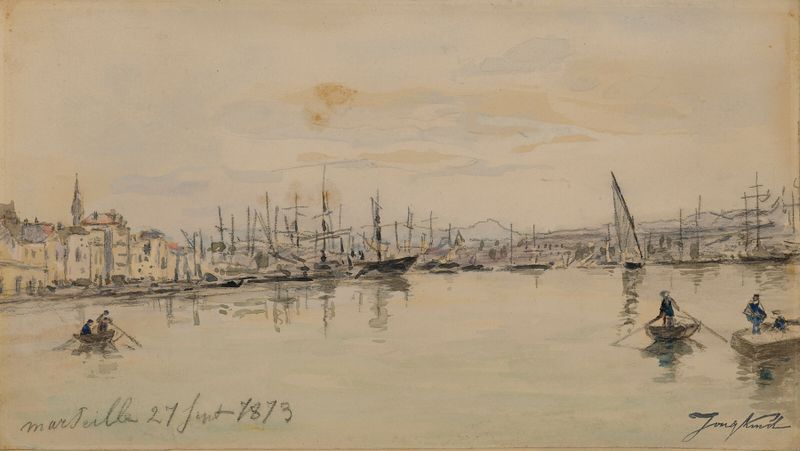
Le Port de Marseille
Johan Barthold Jongkind

Canal Saint-Martin
Johan Barthold Jongkind

Countryside near Brezins, between Grenoble and Vienne
Johan Barthold Jongkind

Notre-Dame vue du quai de la Tournelle
Johan Barthold Jongkind

Environs de Grenoble
Johan Barthold Jongkind

Clair de lune à Overschie (environs de Rotterdam)
Johan Barthold Jongkind

Port de Honfleur
Johan Barthold Jongkind
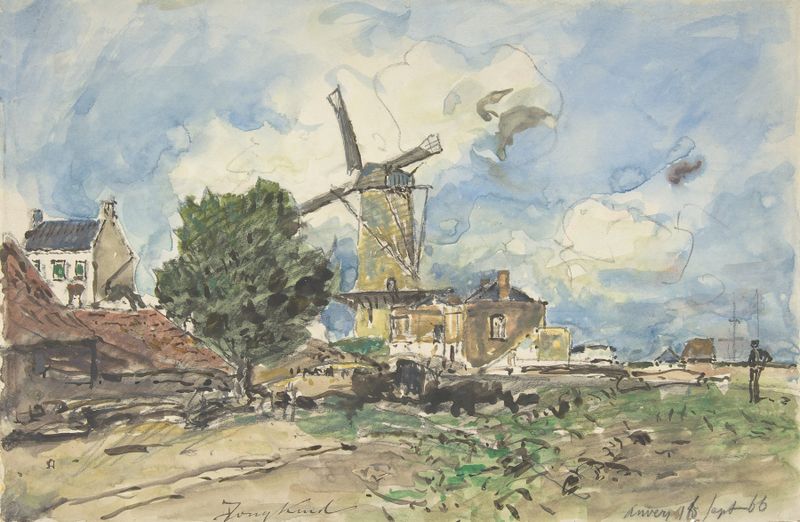
Wind Mill at Antwerp
Johan Barthold Jongkind

Le Havre
Johan Barthold Jongkind

The Church of Overschie
Johan Barthold Jongkind





