
Paysage à la Côte Saint-André — History & Facts
Could beauty survive in a century of chaos? In Paysage à la Côte Saint-André, the answer seems to linger in the gentle strokes of the canvas, whispering tales of a tranquil moment amidst the tumult of a rapidly changing world. Look to the foreground, where the rolling fields reveal a patchwork of greens and yellows, dancing under the subtle embrace of sunlight. The viewer’s gaze is naturally drawn to the soft horizon line, where the cool blues of the sky melt into the warm earth tones below. Jongkind’s brushwork captures the essence of the landscape with palpable immediacy, employing quick, fluid strokes that evoke a sense of movement and life.
The deft use of light and shadow breathes dimension into the scene, inviting us to step into this serene world. Beneath the surface beauty lies a deeper yearning, a nostalgia for simplicity in an era marked by rapid industrialization. The interplay between light and dark in the painting reflects the tension of memory—its fleeting nature, and the longing to hold onto moments of peace. The solitary tree on the horizon stands as a sentinel of time, embodying both resilience and solitude, while the horizon hints at possibilities beyond the frame, akin to the uncertainty of what lay ahead in the late 19th century. In 1886, Jongkind painted this piece while living in France, a time when Impressionism was blossoming yet still in its infancy.
Emerging from the shadows of traditional art, he sought to capture the ephemeral qualities of light and atmosphere, paving the way for future artists. It was an era filled with artistic experimentation, social upheaval, and a quest for new forms of expression, reflecting a world on the brink of modernity.
More Artworks by Johan Barthold Jongkind
Browse all →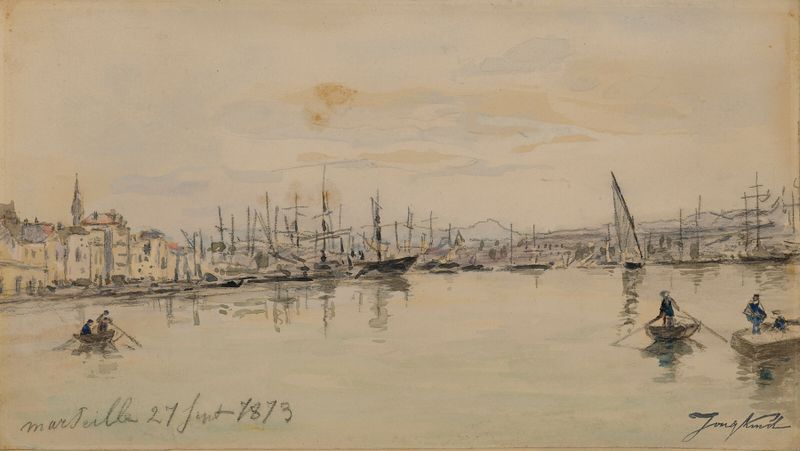
Le Port de Marseille
Johan Barthold Jongkind

Canal Saint-Martin
Johan Barthold Jongkind

Countryside near Brezins, between Grenoble and Vienne
Johan Barthold Jongkind

Notre-Dame vue du quai de la Tournelle
Johan Barthold Jongkind

Environs de Grenoble
Johan Barthold Jongkind

Clair de lune à Overschie (environs de Rotterdam)
Johan Barthold Jongkind

Port de Honfleur
Johan Barthold Jongkind
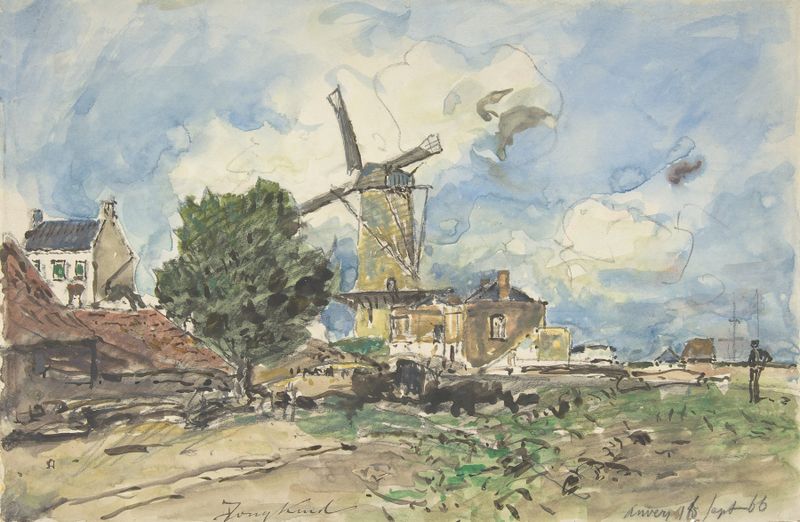
Wind Mill at Antwerp
Johan Barthold Jongkind

Le Havre
Johan Barthold Jongkind

The Church of Overschie
Johan Barthold Jongkind





