
Pochade pour Notre-Dame — History & Facts
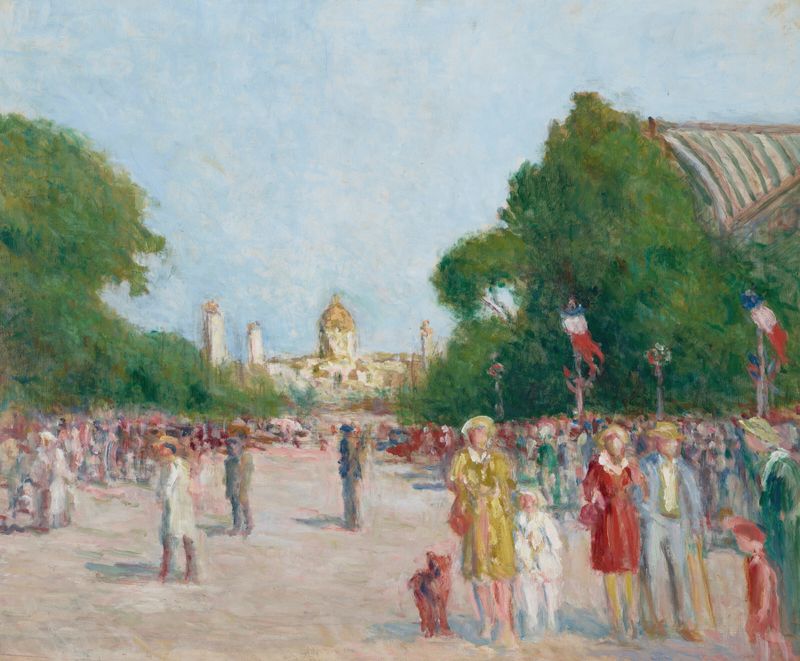
What if beauty was never meant to be finished? In the restless energy of Maximilien Luce's Pochade pour Notre-Dame, the notion of incompleteness takes on an intoxicating allure. Here, we find ourselves drawn into a world teetering on the brink of madness, where the artist's passion spills onto the canvas, inviting us to contemplate the chaotic nature of creation itself. Look to the center of the composition, where the towering silhouette of Notre-Dame emerges, rendered in dynamic brushstrokes that pulse with life. The play of light and shadow dances across the cathedral's façade, illuminating its gothic spires while leaving pockets of darkness that hint at the complexities within.
Notice how the palette shifts from vibrant yellows and blues at the forefront to somber grays in the background, creating a tension that mirrors the artist's own tumultuous spirit. Each stroke feels like an unfiltered emotion, a raw connection to the sacred and the profane. Beneath the surface, contrasts abound: the stable, unwavering structure of the cathedral juxtaposed against the wild, frenetic energy of the surrounding landscape. This tension evokes the struggle between the pursuit of perfection and the madness that often accompanies artistic genius.
The smudged edges and unfinished sections whisper of ideas that flicker like flames, tantalizing yet elusive, suggesting that true beauty is found in the imperfection of the moment. In 1899, Luce was deeply embedded in the burgeoning Post-Impressionist movement. Living in Paris, he sought to capture the city's spirit through innovative techniques that challenged traditional representation. Amidst a backdrop of artistic experimentation and social change, Pochade pour Notre-Dame emerged as a reflection of both personal and collective aspirations, marking a pivotal moment in the evolution of modern art.
More Artworks by Maximilien Luce
Browse all →
Le Quai Montebello Et La Colline Sainte-Geneviève
Maximilien Luce

Le Pont-Neuf, La Seine, Petit Bras
Maximilien Luce
La route aux environs de Méréville
Maximilien Luce
Paysage
Maximilien Luce
Péniches sur la Seine
Maximilien Luce

Notre Dame de Paris
Maximilien Luce
The Quai Saint-Michel and Notre-Dame
Maximilien Luce

La Seine au Pont Mirabeau
Maximilien Luce
L’avenue Winston-Churchill, Paris
Maximilien Luce

Paris, Le Quartier De Vaugirard
Maximilien Luce
More Architecture Art
Browse all →
The statue of Liberty
Frédéric Auguste Bartholdi

View of Houses in Delft, Known as ‘The Little Street’
Johannes Vermeer

View of Houses in Delft, Known as ‘The Little Street’
Johannes Vermeer

The Cathedral in Rouen. The portal, Grey Weather
Claude Monet

The yellow house
Vincent van Gogh

The Church in Auvers-sur-Oise, View from the Chevet
Vincent van Gogh